


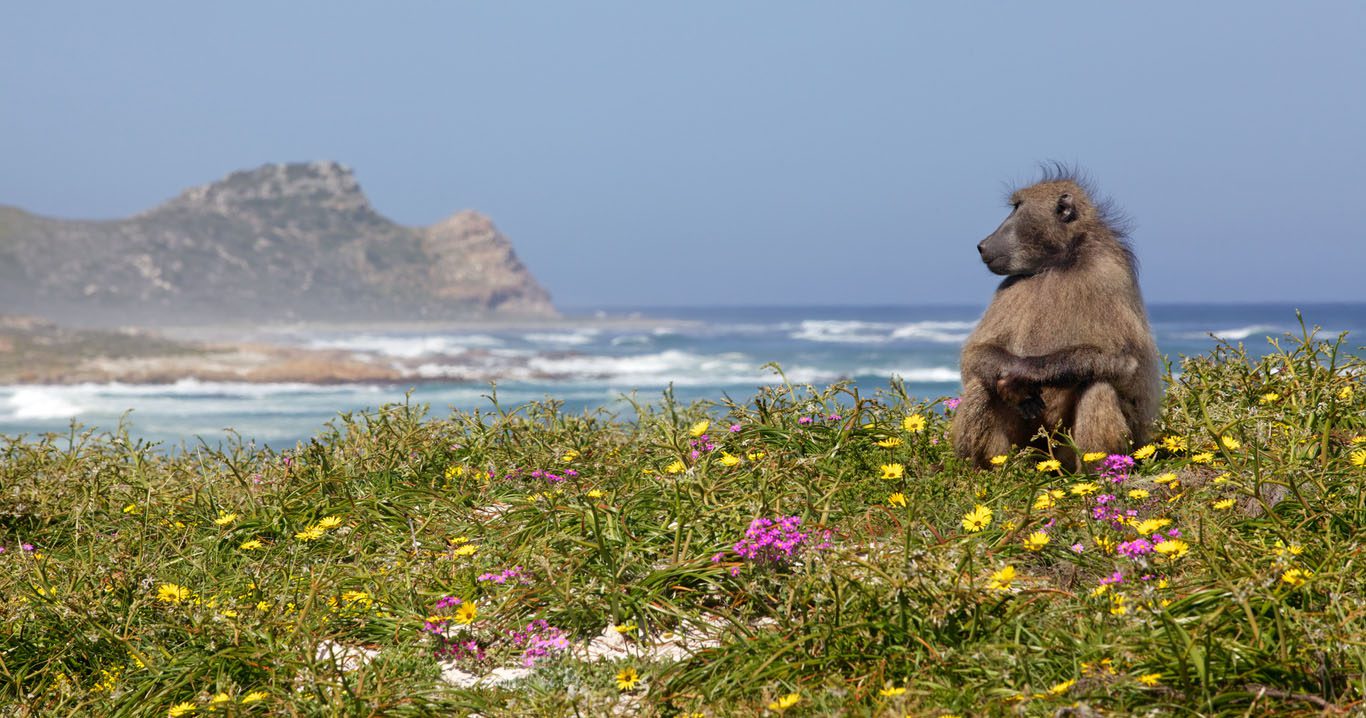
Jun 09, 2026 Living on the Edge: Human–Baboon Conflict in Cape Town
In the 1960s, residents of the Hout Bay suburb in Cape Town would occasionally hear baboons calling from the mountains above the village. The males produced a deep, guttural “bogom” sound. Visitors to the Cape of Good Hope Nature Reserve who parked at the end of the road to Cape Point often encountered baboons wandering through the parking lot. Signs warned visitors not to leave their car windows open, as clever baboons would climb into vehicles in search of food.
Over the years, baboons learned how to open car doors and discovered that homes provided an excellent food source. They began entering houses through open windows and doors, looking for food. Homeowners were understandably concerned about these incursions, prompting the municipality to take action against the roaming baboons. However, deciding how to manage the baboons requires balancing the interests and concerns of baboon advocates, homeowners, the local city administration and any additional constraints. For example, the Cape Floral Kingdom at the tip of South Africa has been designated a UNESCO World Heritage Site, and baboon management must respect the region’s ecological integrity. Managing baboons is a classic “wicked problem” in which possible solutions vary according to participants’ views and perspectives, as described in the next paragraph.
In August 2012, Human Wildlife Solutions (HWS) was awarded a tender by the municipality of Cape Town to manage the baboons on the peninsula, including tracking their numbers. HWS counted 404 baboons on the peninsula in June of 2016, increasing to 445 in June of 2020. An earlier survey at the turn of the century reported there were 360 baboons spread across ten troops on the Cape Peninsula.1 Baboon Matters, an activist NGO developing baboon-monitoring programs to support sustainable solutions for human-baboon interactions, was also founded at the turn of the century. At the same time, a research group at the University of Cape Town, overseen by Professor Justin O’Riain of the Institute for Communities and Wildlife in Africa, started investigating baboon biology and demographics on the Cape Peninsula in 2004. These three entities have been the main advocates in the subsequent discussions on how best to manage baboons on the Cape Peninsula.
Unfortunately, the presence of several organizations investigating baboon management in Cape Town has not produced a broadly agreed approach to managing human-baboon interactions. Adam Welz, a Cape Town resident writing in a Yale University publication, discusses the recently published plan (2025) developed by the City of Cape Town, the Western Cape Nature Conservation Board (CapeNature), and the South African National Parks to reduce human-baboon conflicts around Cape Town and on the Cape Peninsula. He comments that “like most things baboon-related here, it is sparking heated controversy.”
For example, the new plan proposes capping the Cape Peninsula baboon population at 525 individuals: 250 in the northern troops, 175 in the southern troops, and 100 in troops within the Cape of Good Hope Nature Reserve at the southern tip of the Cape Peninsula. The plan proposes capturing and removing two southern troops and placing them in a purpose-built sanctuary that meets the standards set by the Global Federation for Animal Sanctuaries. Meanwhile, the City of Cape Town did not renew the contract with Human Wildlife Solutions, which had employed mostly aversive behavior strategies, such as paintball guns and bear bangers, since 2012. Instead, the City has contracted with a local NGO, Sharkspotters, who have a good reputation for working effectively with local communities, to implement the new plan.
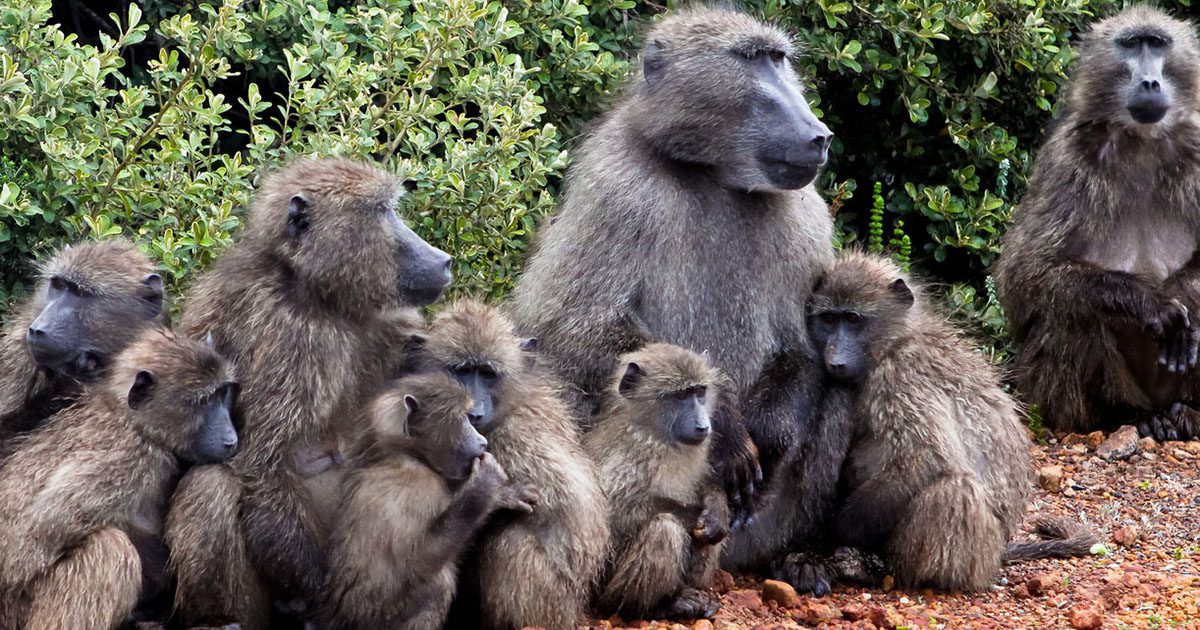
Group of baboons, Image credit: Kristin Verby, iStock
Keeping the baboon population on the peninsula under 525 individuals will require active management. The local baboon population has been growing slowly (about 4% per year) due to high mortality. It turns out that, even in the absence of natural predators – no leopards are living on the Cape Peninsula – baboons living in or close to human habitation suffer from unexpectedly high mortality. A population of 500 baboons would be projected to add 20 new individuals each year, requiring the removal of some individuals (either via lethal control or removal to a sanctuary) every year after the first to keep the population under 525 individuals. Alternatively, some form of fertility control could be introduced to lower the annual increase. For example, elephant populations are being managed in some South African game parks using a contraceptive administered by a remote-controlled dart gun, which prevents fertilization of the egg by sperm and does not disrupt normal elephant behavior. Wildlife fertility control is a new and expanding strategy for addressing human-wildlife conflict and is being actively promoted by the Botstiber Institute.
Research by the University of Cape Town team has also identified several aspects of baboon spatial use that could help reduce human-baboon conflict. For example, encouraging baboon troops to choose their main sleeping place further away from urban development would be expected to reduce human-baboon conflict.
Meanwhile, several communities in the Western Cape – e.g. Greyton, Betty’s Bay and Rooi Els – have developed approaches that reduce human-baboon conflict while allowing baboons to live relatively undisturbed. However, these communities are much smaller and less complex than those on the Cape Peninsula. Also, the human residents generally have a high tolerance for the baboons, who have not yet learned the destructive behaviors of their cousins on the Cape Peninsula.
Today, the human-baboon edge has become a crowded, contested space where the boundaries between human communities and wildlife are increasingly blurred. Yet the story of Cape Town’s baboons is not only one of conflict but also of coexistence—of how human choices, from urban expansion to waste management, shape outcomes for both species. Living on the edge means more than proximity; it requires responsibility, understanding, and a willingness to adapt. The future of these interactions will depend not on pushing wildlife further away, but on finding safe and effective ways for both humans and baboons to share a rapidly changing landscape with respect and care.
Image credit: ZambeziShark,iStock
1. A brochure by Ruth Kansky, published by the International Fund for Animal Welfare in 2002, describing baboon demographics and biology on the Cape Peninsula