


May 26, 2026 Restoring Floreana Together: Giant Tortoises, Community, and a Shared Future
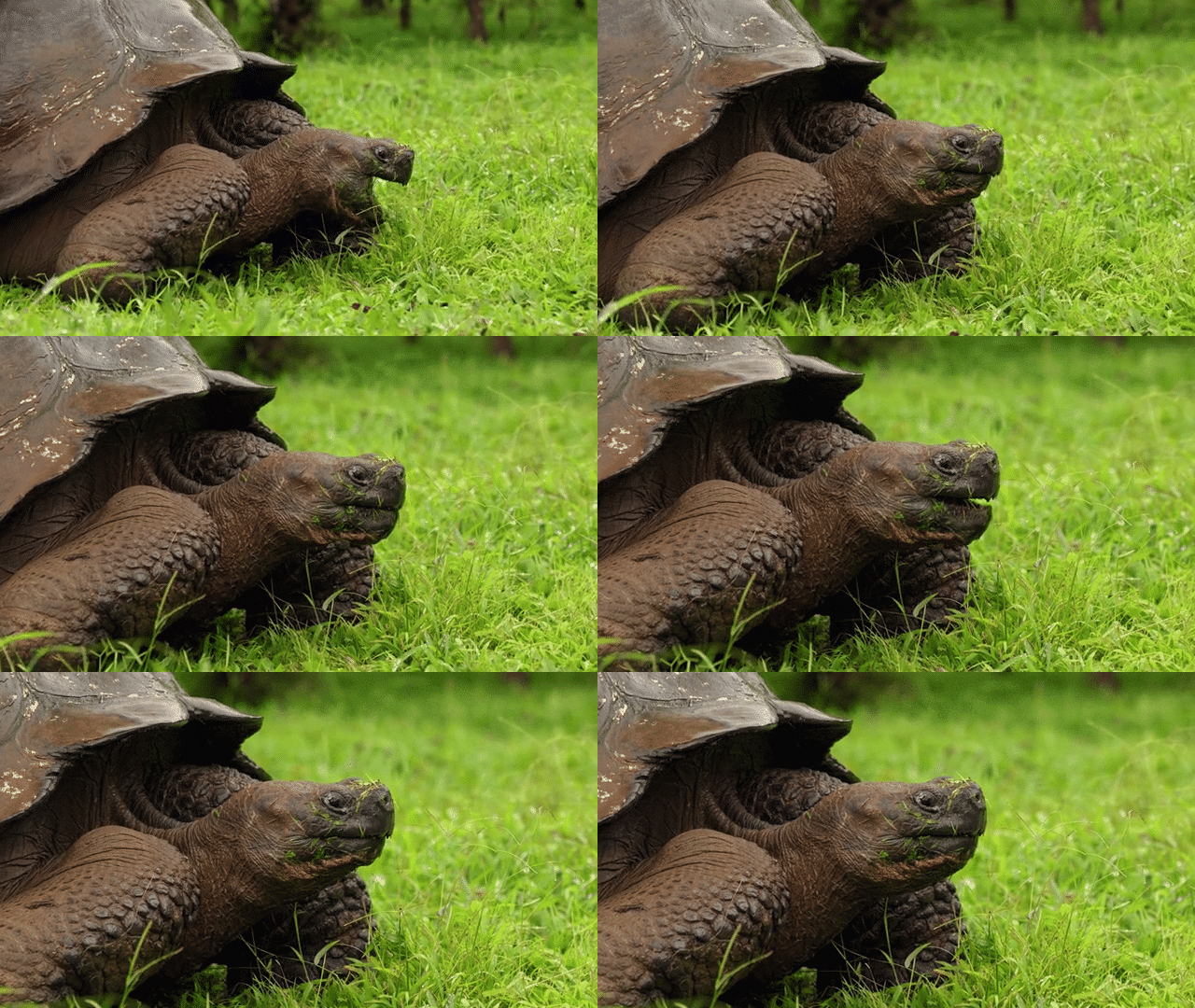
For nearly two centuries, Floreana Island in the Galápagos was missing one of its most important inhabitants. Giant tortoises—once the slow-moving “gardeners” that shaped the island’s landscape—had vanished, leaving behind an ecosystem invaded by rats, feral cats, and other domestic animals that arrived alongside the human settlers. Today, the return of the tortoises is not only rewriting Floreana’s ecological story but also demonstrating what is possible when science, community, and long-term commitment come together. The giant tortoise may not command the same visual attention as the Oryx described in an earlier newsletter, but it is an important ecosystem engineer for Floreana Island. The release of 158 juvenile giant tortoises from the Floreana lineage is a significant step in a project to restore 12 of the island’s original species that have disappeared.
Giant tortoises (Chelonoidis niger niger) were extirpated from Floreana in the mid-1880s primarily due to sailors who removed them for fresh meat during long voyages to and from Europe. Additionally, the introduction of rats and other animals by humans led to the predation of tortoise eggs. Floreana was one of the first islands to be inhabited by humans, and today, approximately 160 people live there. The current inhabitants strongly support an ambitious effort to restore the 12 original species. The initiative is led by the Galapagos National Park Directorate and the Galapagos Biosecurity Agency, in partnership with Fundación Jocotoco, Island Conservation, and the Charles Darwin Foundation. According to Veronica Mora, a Community Representative from the island, the return of the giant tortoises,
“… shows what is possible when a community leads, and many partners come together with a shared purpose. This moment marks an important step toward a future where conservation and community wellbeing go hand in hand—because our livelihoods, from tourism to agriculture and fishing, depend on the health of this island.”
Restoring the Floreana ecosystem to resemble the island’s state when Darwin first visited the Galapagos is a complex and challenging project. To achieve this, introduced species such as rodents, feral cats, goats, donkeys, and cattle must first be removed. Additionally, the appropriate giant tortoise species needed to restore vital ecosystem engineering services had to be identified.
The absence of an appropriate giant tortoise subspecies was resolved when a team investigated tortoises with saddleback-shaped shells living on the slopes of the Wolf Volcano in the northern part of Isabela Island. The Isabela giant tortoise species had domed shells, while those found on Floreana, Española, and Pinta Islands in the Galápagos had saddleback shells.
The team identified 86 individual tortoises on Isabela Island with saddleback shells that had a genetic make-up associated with the extinct Floreana subspecies. It is believed that 19th-century sailors may have offloaded tortoises collected from Floreana onto Isabela Island when they encountered bad weather or threats from other sailors and that those tortoises then interbred with the Isabela subspecies.
The team transported 30 tortoises with distinctive shell shapes from Isabela Island to a captive-breeding colony on Santa Cruz Island. Of these, 23 animals—9 males and 14 females—became the founders of a breeding colony producing tortoises that had a close match to the Floreana Giant Tortoise subspecies.
In late 2023, poison bait was deployed across Floreana Island, significantly reducing rat and feral cat populations. This intervention led to dramatic outcomes, including the recovery of several bird species and the return of individual Galapagos Rails—birds not seen on the island since Darwin’s time. The populations of native snails, lizards, geckos, Galapagos doves, and the critically endangered Galapagos Petrel also flourished. In 2024, 700 nesting pairs of Galapagos Petrels and 154 fledglings were recorded. Additionally, farmers reported full harvests for the first time in years, thanks to the decline in rat numbers. However, the most notable achievement of the Floreana Restoration Project was the release of 158 giant tortoise juveniles with Floreana genetic lineage, marking the return of these ecosystem engineers after 180 years of absence.
The project is now looking to restore another 10 species, including the Floreana Mockingbird, the Little Vermilion Flycatcher and the Floreana Racer (a snake), which became extinct on the island following human settlement. However, some individuals of these species survived on neighboring islets.
Wildlife monitoring on Floreana has now been enhanced with camera traps and artificial intelligence to track wildlife interactions across the island. This system is similar to the technology used on Kangaroo Island, Australia, to monitor and control feral cat populations. The implementation of remote, motion-sensor cameras combined with artificial intelligence (AI) to identify and extract useful images is a tremendous time-saver.
Island conservation is gaining global momentum, thanks to the NGO Island Conservation and its partners. Interestingly, restoring island ecosystems also significantly benefits the surrounding marine ecosystems.
The return of Floreana’s giant tortoises is more than the reintroduction of a single species—it is a powerful demonstration of how ecosystems, communities, and livelihoods are deeply interconnected. As these slow-moving “gardeners” resume their role in shaping the landscape, they help restore not only the island’s ecological balance but also its resilience for future generations. Floreana’s story underscores a broader truth: when conservation is driven by local communities and supported by science and collaboration, even the most ambitious restoration goals become possible. Across the world, similar efforts are gaining momentum, offering hope that degraded ecosystems can recover—and that human wellbeing can flourish alongside them.
Video by: BlackBoxGuild-iStock-1892700849