



Mar 27, 2026 Back from the Brink: How Reintroduced Species Are Transforming Their Ecosystems
The scimitar-horned oryx is a large antelope, weighing between 300 and 400 pounds. It is known for its striking appearance, with a beautiful combination of white and red fur and long, curved scimitar-like horns. Historically, these oryx roamed the grasslands bordering the Sahara Desert, with their population once estimated in the hundreds of thousands or even millions. However, excessive hunting, especially with the introduction of high-powered rifles and motorized vehicles, drastically reduced their numbers. As a result, the wild population was declared extinct in the wild by the International Union for Conservation of Nature (IUCN) in 2000.
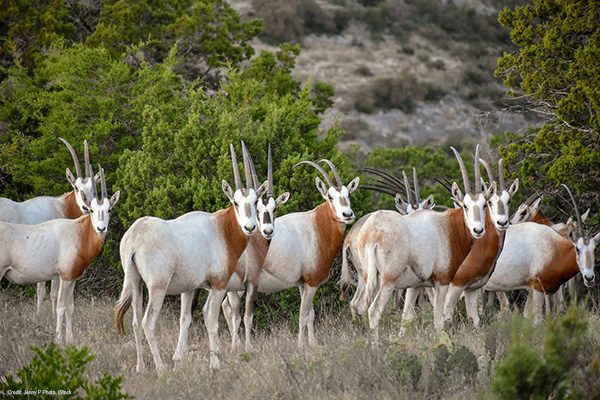 Most likely due to its striking appearance, thousands of scimitar-horned oryx were kept in zoos and captive facilities across the globe. This situation sparked discussion of reintroducing the species into the wild. Eventually, the Sahara Conservation NGO, the Abu Dhabi Environment Agency, and the Government of Chad collaborated on a plan to release captive-raised oryx into a protected area in Chad, namely the Réserve de Faune de Ouadi Rimé-Ouadi Achim (RFOROA), which covers 78,000 square kilometers.
In March 2016, the first oryx were released in RFOROA. Approximately 380 oryx were eventually released, and by the end of 2023, the population had grown to around 600 individuals due to successful reproduction. This increase in population led the IUCN to downlist the oryx from “Extinct in the Wild” to “Endangered.”
The oryx population is not only increasing in number but is also beginning to influence the reserve’s ecology. Scimitar-horned oryx are adapted to desert life; they can endure high temperatures and obtain water from wild melons. Additionally, their feces contain seeds surrounded by natural fertilizer, which enhances the likelihood of those seeds germinating. The oryx also dig into the ground to find water, breaking up the soil crust and allowing rain to penetrate rather than running off into waterways. Known as ecosystem engineers, these antelope are already contributing to improvements in the Reserve’s vegetation.
The oryx are not out of danger yet, but their restoration signifies that extinction in the wild does not necessarily mean they are lost forever. Meanwhile, on the other side of the world, Floreana Island in the Galapagos has just welcomed around 300 giant tortoises. These tortoises are genetically related to the original population that inhabited the island before they were extirpated around 1850. Like the oryx, these tortoises are also considered ecosystem engineers. Their movements and feeding habits play a crucial role in reshaping Floreana’s landscape by spreading seeds and controlling invasive plant species.
For centuries, Galapagos giant tortoises were a crucial food source for hungry sailors who removed an estimated 100,000 from the islands between 1774 and 1860. This exploitation drove three giant tortoise species to extinction, with the Floreana tortoise being the first to go. Floreana was one of the few islands in the Galapagos that had an easily accessible source of fresh water.
In 2000, a team of conservation scientists observed tortoises with saddleback shells, a feature of the original Floreana species, on Isabela Island in the Galapagos. Genetic studies indicated that these tortoises were hybrids carrying genes from the Floreana giant tortoise. This discovery eventually led to the establishment of a breeding program to produce a giant tortoise with Floreana lineage for reintroduction to the island. Residents supported the Floriana Ecological Restoration Project, and in February 2026, 158 juvenile giant tortoises of the Floreana lineage were released on the island. The project plans to restore an additional twelve native species to the island.
The examples of the oryx and the tortoise suggest that extinction may not be forever. Additionally, these two examples highlight the importance of keystone species, especially ecosystem engineers, in the planning and execution of species restoration projects. Although it is too soon to evaluate the impact of the newly introduced members of the Floreana ecosystem, supporters predict that the impacts will benefit not only the island’s ecosystem but also its human residents, who rely on tourism revenues, as well as the surrounding marine ecosystem.
Video credit: Aquiles Fernandez, iStock