



Apr 29, 2026 From Cages to Compassion – Ending Bear Bile Farming in Vietnam
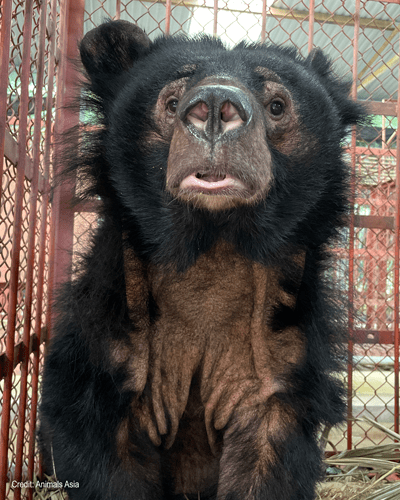
Dawn
Our team in Vietnam knew almost immediately what was wrong with the newly rescued Dawn. Confiscated from a bear farm after 20 miserable years of being caged and intubated to extract her bile, Dawn was not only presenting serious physical problems, but was showing all the mental signs of “learned helplessness.” Her body and her mind were beginning to shut down.
For decades, Asiatic black bears (or moon bears, after the beautiful lemon crescent of fur on their black chests) have suffered across Asia due to the bile farming industry. A practice that sees their bile cruelly extracted from their gall bladders for use in traditional medicine, despite the many herbal and synthetic alternatives available today.
In Vietnam, where Animals Asia has been working since 1999, we have rescued nearly 300 caged bears and signed an official Memorandum of Understanding with the government to end bear bile farming once and for all in 2026.
Bears kept in the farms develop a multitude of physical and psychological problems. Lying on cage bars for decades, they suffer from chronic mobility complications, compromised skin and hair loss, nutritional defects, broken and rotten teeth, stress-related issues such as hypertension, heart disease and associated problems related to their eyes, even causing blindness. Bears often have multiple tumors and cancers, especially connected to liver and gall bladder complications resulting from the cruel and constant extraction of their bile.
Our approach at Animals Asia is “holistic.” We gratefully work with the authorities, local communities, traditional medicine practitioners, businesses and even the bear bile farmers themselves to identify the bears in need, negotiate their release and carry out complex rescues into our two sanctuaries in Tam Dao in the north and Bach Ma in central Vietnam, where they will receive care for the rest of their lives.
Following our agreement with the Vietnamese authorities, Animals Asia also signed a memorandum with the country’s largest traditional medicine association, with some 60,000 members, celebrating their pledge never to prescribe or sell bear bile again. In tandem with this, we began working with traditional doctors and a local business group, Cocoon, to research and develop a herbal balm alternative to bear bile that is now being distributed without charge in bear farming hotspot communities in northern Vietnam. At free monthly health checks for older adults, doctors not only examine patients but also prescribe the herbal balm as a replacement for bear bile. Feedback confirms that this alternative is not only considered as good as bear bile, but often better, with one gentleman returning for more and identifying himself as a local bear bile farmer!
Reducing demand is crucial, and together with the country’s doctors, we’ve produced a bilingual herbal remedy book rooted in centuries of traditional wisdom and featuring over 40 of Vietnam’s plant alternatives to bear bile.
Many of these herbs are also grown in schools across the country by eager young students who passionately embrace solutions to end bear captivity and help set them free. Thousands of students are engaged in bear-themed events designed to teach empathy and environmental stewardship. Interestingly, many such students are the sons and daughters of bear farmers and have been known to encourage their parents to release their bears into our care.
Around 150 bears currently remain on farms across the country. Some of the bear farm owners are reluctant to give up their bears. Some fear prosecution or media embarrassment, while others consider their bears family members and doubt that our sanctuaries can care for them responsibly. Such fears are understandable given the decades they have lived with their bears. Together, the authorities and Animals Asia address these concerns with a rare, rational approach when addressing compromised animal welfare and sentience. Owners are assured that they will not be punished or embarrassed in the media when surrendering their bears.
Instead, they are encouraged to visit our sanctuaries to see for themselves that their animals will enjoy a wonderful last chapter of their elderly lives. Here, their bears will be introduced to a rich tapestry of grassy enclosures, swimming pools, enclosure furniture on which they can climb, rest and play, as well as new bear friends to be integrated with and form engaging friendships. An expert team and state-of-the-art hospital will be waiting to nourish them, medicate them, perform necessary surgeries, and enrich their days.
When bears like Dawn arrive with trauma that seems almost impossible to treat, our team understands and helps them with sophisticated knowledge, expert intervention and a very large prescription of tender loving care.
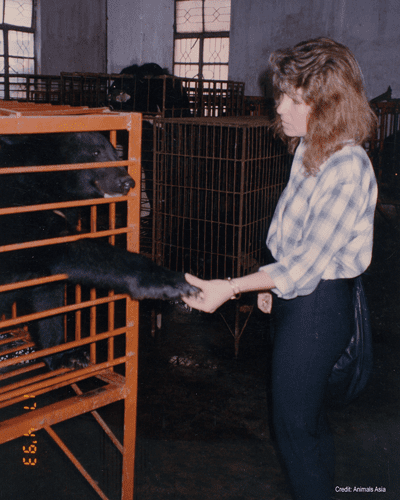
Jill holding Hong’s paw in 1993
As Dawn blinked out of her cage on that day on the farm, we could see that her eyes had lost all hope. Back in our quarantine area, she would press her head against the bars of her recovery cage, turn away from people and curl herself tightly into a miserable ball of sadness. Even when she had eaten, her body turned away once more, never daring to hope that there was anything but pain around the corner. Almost naked with hair loss, the saddest thing was to see that her very identity, the signature golden crescent moon of lemony fur, was also missing from her chest.
Never beaten, our team worked to understand Dawn, to care for her wounds, to address her mental state, to show her she was loved. For the first time, she had banana leaves to lie upon, a rotating smorgasbord of delicious food, medication to remove her pain and a never-ending supply of treats such as tasty dried fruit, fresh veg and frozen ice pops. Music played in the background as “white noise” to distract her from the sounds the other bears made in quarantine, too – and slowly, very slowly, Dawn began to respond.
As the weeks went by, this traumatized bear began replacing learned hopelessness with learned happiness as she dared to believe that she would never be hurt again. And today, in a den and enclosure with Twilight and her new best friends, Dawn is flourishing as she potters contentedly in the grass, foraging to her heart’s content. At the last count, her little chest crescent had grown about six blonde hairs – her identity returning, and allowing a world of supporters to celebrate that she is a moon bear once more.
One bear began this journey in 1993, when she stretched her paw through the bars of a bear farm cage and touched my shoulder. I named her Hong (“bear” in Cantonese) and, while I never saw her again, I promised her that bear farming would end.
This year, Hong will be the name of the last bear to pass through the sanctuary gates. In memory of a bear we could not save, and in acknowledgment of one who began it all, her name carries the weight of both loss and progress — and a reminder of how long meaningful change can take.
Animals Asia was founded in 1998 by Jill Robinson MBE, the world’s leading authority on bear bile farming. Animals Asia has been changing the world for animals for over two decades. Based in Hong Kong, we work across Asia to replace cruelty with compassion and create lasting change. Please visit Animals Asia’s website to learn how you can help the moon bears of Asia.