



Jun 11, 2025 U.S. Animal Shelter Demographics: Trends & Issues
In the early 1970s, numerous reports in publications such as Science and the Bulletin of the Atomic Scientists and in popular media highlighted the problem of free-roaming dogs in nearly every American community. Veterinarian Dr. Max Feldman noted in the Science editorial that some roaming dogs are pets that can wander freely. The number of free-roaming dogs largely depends on the attitudes of dog owners regarding pet confinement. The dog and cat “overpopulation” crisis of the early 1970s led to two national conferences in 1974 and 1976, which were attended by representatives from all major stakeholders involved in pet care. A popular strategy to address this issue was summarized by the initials LES, which stood for Legislation, Education, and Sterilization.
U.S. Animal Shelters and Rescues
In 1973, the Humane Society of the U.S. (currently known as Humane World for Animals) conducted a study on animal intake rates in the country’s shelters. They estimated that approximately 13.5 million dogs and cats were euthanized each year in these shelters. Later, Merritt Clifton emphasized the need for shelters to use standardized figures for intake and euthanasia. He popularized a measurement that reflects the number of dogs and cats entering shelters per 1,000 people in a community. Clifton applied this approach to the data he collected on shelter euthanasia in the U.S. and created a table with estimated euthanasia figures for the nation.
Whether one considers the figure of 13.5 million or 23.4 million for national shelter euthanasia of animals in the 1970s, it is easy to see why concerns emerged about dog and cat “overpopulation” and the alarming euthanasia rates during that time, particularly when there were only an estimated 65 million pet dogs and cats in the U.S.
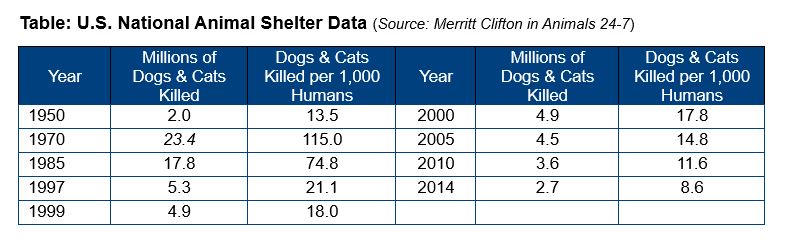
More recent data shows that this issue has largely been resolved. Estimates from Shelter Animals Count and Best Friends Animal Society indicate that national animal shelter dog and cat intake has decreased to approximately 4.8 million (according to Best Friends) or between 5.8 million and 6.9 million dogs and cats in 2024 (according to Shelter Animals Count). Euthanasia rates for 2024 have also dropped to around 2.5 dogs and cats euthanized per 1,000 people, which translates to roughly 850,000 dogs and cats euthanized in total.
While progress has been made, there is still room for improvement. The United Kingdom currently euthanizes around 0.1 dogs and cats per 1,000 people in its shelters.
In 2016, Best Friends Animal Society announced a goal to make every animal shelter in America “No-Kill” by the end of 2025. A “No-Kill” shelter is where at least 90% of the animals that enter the shelter leave alive. To kick off the campaign, Best Friends identified every brick-and-mortar shelter in the United States they could find, enumerating approximately 4,000 shelters. Additionally, they began tracking shelter intakes and outcomes.
Shelter Animals Count (SAC), an initiative launched in 2012 by a consortium of major animal protection organizations (including Best Friends) and animal welfare foundations, aimed to develop national data on animal shelter intakes and outcomes. In 2016, SAC formally initiated its national shelter database. In 2023, Shelter Animals Count estimated there were 4,915 brick-and-mortar shelters in the country, along with an additional 9,514 animal rescues.
The reasons for the discrepancies between Best Friends and Shelter Animals Count in their estimates of the total number of shelters and animal intakes across the United States are unclear. Shelter Animals Count compiled its list of shelters and rescues using the Adopt-A-Pet online database, while Best Friends developed its list by contacting every brick-and-mortar shelter it could find. In 2024, Best Friends reported a total of 3,862 shelters in the United States, while Shelter Animals Count’s initial estimate for 2024 had dropped from 4,915 shelters listed in 2023 to 4,110 shelters.
In a 2009 project conducted by the Humane Society of the United States, approximately 3,750 shelters were identified that house animals in physical buildings instead of rescue organizations that typically operate with animals housed in volunteers’ homes. Around the same time, ZooToo (now defunct) published a list of 3,657 shelters in the United States.
Although the exact number of animal shelters fluctuates annually, due to some shelters closing and others opening, the number has generally increased over time. Currently, there are likely around 4,000 brick-and-mortar shelters across the country.
It seems unlikely that Best Friends will achieve its goal of a No Kill America by 2025, but they are expected to come close. It is probably better to set an ambitious goal and nearly achieve it than to aim too low. As Julie Castle, Best Friends’ CEO, mentioned in a recent blog, attaining no-kill status is no longer uncommon for shelters. In 2023, more than half of the shelters in the U.S. achieved no-kill status (2,268 out of 3,922). Today, over 80% of American shelters are live-releasing 80% or more of their animal intake. This represents a remarkable turnaround from 1973, when approximately 13.5 million dogs and cats were killed in the nation’s shelters, accounting for an estimated 60-70% or more of total animal intake.
Video credit: wavebreakmedia, iStock