


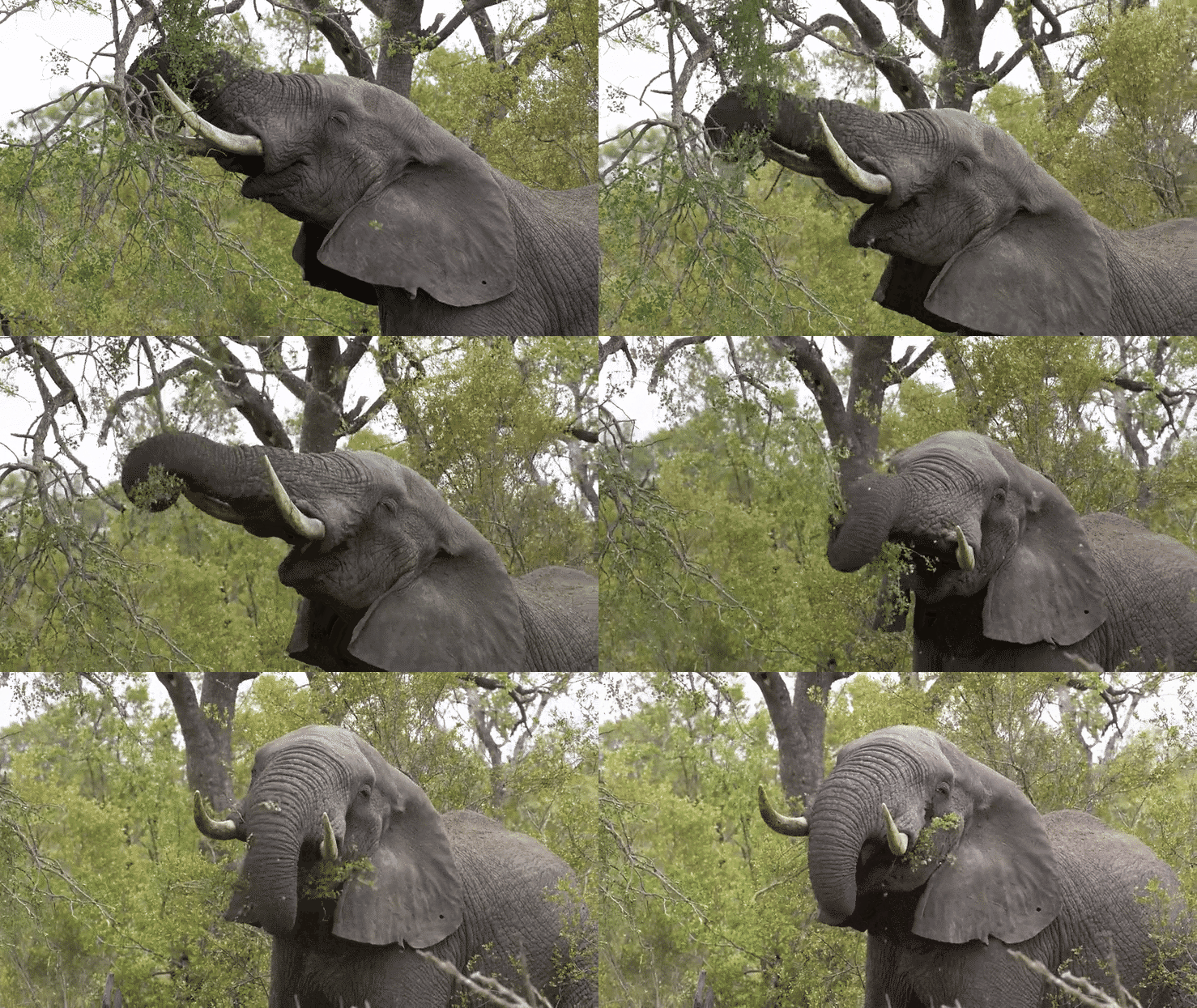
Mar 12, 2026 African Elephants and Big Trees
Southern Africa, particularly the Kruger National Park and the adjacent conservancies within the Associated Private Nature Reserves (APNR), is facing significant challenges regarding elephant management. For several decades, from 1967 to 1994, the population of elephants in Kruger National Park was kept low, between 7,000 and 10,000 individuals, through a culling program that targeted selected family groups. However, this culling program faced growing criticism from local animal advocates and international tourists and was ultimately halted in 1994.
Today, the elephant population in Kruger National Park is estimated to be over 30,000, with an additional 3,000 in the neighboring APNR reserves. This sharp increase in elephant numbers is putting considerable pressure on large trees and igniting intense debates about how to protect these trees, the elephants, and overall biodiversity in the semi-arid lowveld ecology of eastern Southern Africa.
At the end of October 2025, a two-day conference was held in Zimbabwe to discuss “The Elephant in the Room” and strategies for elephant management in Southern Africa, with particular focus on elephants in Gonarezhou National Park. This park is located on the border between Zimbabwe and Mozambique, just northwest of South Africa’s Kruger National Park.
The various game parks in this region are part of the Greater Limpopo Transboundary Conservation Area, which spans parts of South Africa, Zimbabwe, and Mozambique. Gonarezhou National Park currently has one of the highest elephant densities in Africa, with more than 2 elephants per square kilometer and a total population of approximately 11,500.
Elephant numbers in Zimbabwe have grown significantly—from around 4,000 in the early 1900s to over 90,000 today—making Zimbabwe home to the second-largest elephant population after Botswana. Ecologist Professor David Cumming notes that under favorable conditions, elephant populations can double in 12 to 15 years, while woodland vegetation can take over a century to recover from the damage caused by elephants.
Damage to large trees, particularly baobabs and marulas, has become a significant indicator of elephant overpopulation across southern Africa. However, conservationists Sam Ferreira and David Balfour recently argued that managing wildlife solely by numbers is ineffective. Instead, they suggest that conservation managers first identify their goals for a specific ecosystem and then implement appropriate conservation practices to achieve them.
For example, Kruger National Park managed its elephant population through culling until 1994. While this kept the elephant population at or below 10,000 individuals, the populations of many antelope species in Kruger declined in the early 1990s. Although the elephant population has tripled from 10,000 in 1994 to over 30,000 today, antelope populations have been recovering slowly since that time.
Ferreira and Balfour also contend that elephant-caused tree damage is highly selective and occurs in patchy patterns. Reducing the complex savanna ecosystem of Kruger Park to manage stocking rates and carrying capacity is better suited to enhancing productivity in an agricultural setting than to preserving the dynamic, biodiverse ecosystem of Kruger Park and its surroundings.
In the past, earlier management teams of Kruger Park aimed to create a predictable landscape, featuring open grasslands in some areas, thickets in others, and large trees lining the riverbanks. Their main strategies included structured burns, fencing, controlling large mammal populations through culling, and providing artificial water sources in dry regions. As Ferreira and Balfour point out, Kruger Park was being managed as if it were a large game farm.
As our understanding of nature has improved, conservation goals have increasingly focused on maintaining biodiversity and preserving ecosystems in their most intact and functional states. This approach highlights that elephants should not merely be seen as detrimental to trees; rather, they play a crucial role as ecosystem engineers. When concerns arise about elephants’ impact, managers need to investigate the causes of that impact and develop targeted management strategies to address it effectively.
The Kruger Park is not an isolated ecosystem. Genetic studies show that elephants in Kruger have breeding connections with those in Chobe National Park in Northern Botswana. These connections highlight the effectiveness of the Greater Limpopo Transfrontier Conservation Area, which allows animals to move across international borders into neighboring parks and conservation areas. It appears that when animals do not venture outside a protected area, it may be because they are aware of “fear landscapes.” Research indicates that elephants, on average, are killed by hunters within one to two kilometers of a protected area boundary. Consequently, elephants have quickly adapted by avoiding areas where hunting is permitted.
Tall trees are often considered important nesting habitats for African vultures. However, within the Lowveld ecosystem, several vulture species coexist, some of which are thriving while others are declining. The greatest threat to vulture populations comes from humans who poison animal carcasses, partly to prevent rangers from quickly locating poached carcasses by following descending vultures. Therefore, the loss of large trees for nesting is not the main issue. As Ferreira and Balfour conclude,
“Kruger does not need rescuing from elephants. It needs us to stop trying to force it into our favorite postcard vision and to strengthen our efforts to manage it as the dynamic, messy, and evolving socioecological system that it is. That means letting go of easy numbers and embracing more difficult questions.”
Credit: BlackBoxGuild, iStock