


Aug 20, 2026 The Slow Transformation of Biomedical Research
Introduction
Recent articles defending or examining animal research are common in North America and Europe, but much less common from scientists in the Global South. Mario Treviño and Oscar Arias-Carrión from Mexico are exceptions to that rule and have produced an excellent analysis of the current “[S]tructural shifts and constraints in animal-based neuroscience.” Their 2026 analysis explores the structural changes occurring in animal-based neuroscience research and offers insights into where the field may be headed.
Signs of Change in the United States
The authors do not mention the recent developments in primate research in the United States that support their analysis. David Grimm, a journalist at Science, has tracked a debate over the future of the Oregon National Primate Center, where local politicians have pushed to close the Center, home to around 5,000 monkeys.
Meanwhile, two of the remaining six national primate research centers have replaced the word “primate” with “biomedical” in their website names, and Robert Kennedy, Secretary of the U.S. Department of Health and Human Services, has stated that he is deeply committed to ending animal experimentation in the United States.
The Harvard University newspaper, The Crimson, recently revisited the university’s 2013 closure of the New England Primate Research Center, following several incidents involving animal care and primate deaths at the Center. The Harvard administration evidently decided that it was not worth continuing to operate the Center.
The Oregon Health Sciences University, under pressure from Oregon politicians, appears to have been heading in a similar direction to Harvard, but has stepped back from closing their center.
 Historical Context
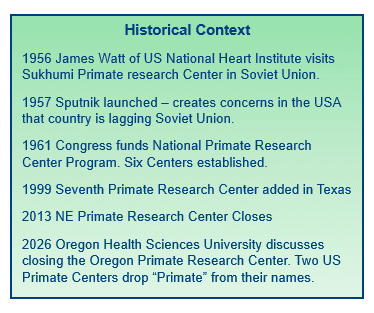
The National Primate Research Center program was initiated after the launch of Sputnik, the first satellite in space, by the Soviet Union on October 4, 1957. This event raised concerns that the United States was falling behind Russia in terms of scientific and technological development. James Watt, who was the Director of the National Heart Institute, had visited the Russian primate research center in Sukhumi in 1956. Upon his return, he argued that the United States should establish its own primate research centers. In 1961, Congress approved funding to create six National Primate Research Centers across the country. A seventh center was added in Texas in 1999.
 Declining Public Support
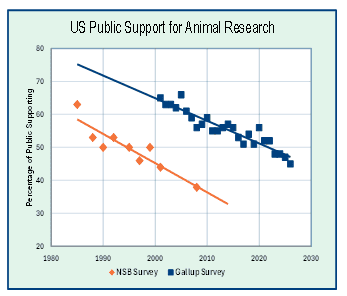
However, public support for animal research has been declining for decades, as illustrated by two separate annual surveys: one conducted by the National Science Board (NSB) from 1985 to 2001 (a separate 2008 survey also used the NSB statement) and the other conducted by Gallup from 2001 to 2026.
The Gallup survey asks if medical experimentation on animals is morally acceptable. In contrast, the NSB statement is more nuanced and addresses the use of chimpanzees and dogs in research leading to human health benefits. The responses to the two surveys indicate that survey wording influences attitudes, but both show a very similar and steady decline in public support for animal use in laboratories.
The NSB survey indicates far less public support for the use of chimpanzees (and possibly other primates?) in laboratory research than for the use of generic laboratory animals cited in the Gallup survey. Declining public support and the cost of chimpanzee research likely influenced the 2015 decision by NIH to end invasive research on chimpanzees and to support the retirement of around 360 chimpanzees housed in laboratories to permanent sanctuaries. The focus of opponents of animal research has now shifted from chimpanzees to other laboratory animals, including other primates and dogs.
Searching for Alternatives
The Oregon Health Sciences University (OHSU) explored several alternatives for its National Primate Center. For example, OHSU considered turning the primate center into a primate sanctuary, but the projected costs of the transformation were too high. They also considered turning the primate center into a center for the development of NAMS, that is, new approaches that do not use animals. That option was also ultimately rejected, in part because of the costs.
Although these proposals were ultimately rejected, they illustrate how institutions are beginning to consider futures that rely less heavily on traditional animal research.
Conclusion
The two Mexican scientists conclude their analysis with the hopeful comment:
“Animal-based neuroscience is undergoing a structural transition rather than a decline. Regulatory, ethical, and economic pressures, together with advances in human-based, in vitro, and computational approaches, are narrowing the range of questions for which animal experimentation is the default strategy. No single model provides comprehensive explanatory power; progress increasingly depends on the integration of complementary systems.”
However, public opinion trends indicate that laboratory animal use in neuroscience will likely continue to decline and possibly become less invasive thanks to new imaging technologies.