



Nov 12, 2026 The Remarkable Turnaround of Pet Overpopulation in the United States in the Past 50 Years
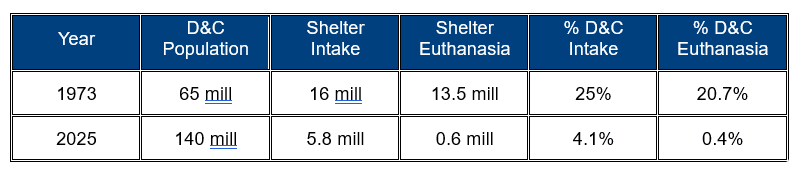
In the 1960s and 1970s in the United States, animal shelters were inundated with stray and unwanted dogs and cats. In 1973, for example, animal shelters in the United States took in 15-17 million dogs and cats. They euthanized approximately 13.5 million, according to a survey conducted by the Humane Society of the United States (now Humane World for Animals). In 1973, there were approximately 65 million pet dogs and cats in the United States.
In 2025, there were approximately 140 million pet dogs and cats in America. According to Shelter Animals Count (a department of the American Society for the Prevention of Cruelty to Animals), animal shelters in America took in 5.8 million dogs and cats and euthanized just under 600,000 in 2025.
The Table below illustrates the remarkable improvement in animal sheltering over the past 52 years.
Numbers (in millions) and Percentages of Dogs and Cats Entering and Euthanized in American Animal Shelters Annually.
Two important articles on pet overpopulation also appeared in academic journals in the early 1970s. One was authored by Carl Djerassi (the father of the birth control pill) and his colleagues and appeared in the Bulletin of Atomic Scientists in January of 1973 under the title “Planned Parenthood for Pets.” The second was an editorial in Science magazine by veterinarian Bruce Max Feldman titled “The Problem of Urban Dogs” that appeared in September of 1974. Both articles emphasized the public health, ecological and management costs of roaming dogs and cats.
Also in 1974, a conference of all the major stakeholders involved in pet acquisition, management and rescue was convened in Chicago to discuss what had become known as the dog and cat “overpopulation” problem. Despite several presentations arguing that surgical sterilization could not solve the “overpopulation” issue (including one by the President of the Humane Society of the U.S.), surgical sterilization of pets became part of a broader approach to resolve the challenge of limiting shelter euthanasia of healthy animals and generate a balanced pet population where the production of puppies and kittens more closely matched the number of dogs and cats dying each year, not including shelter euthanasia of healthy but unadopted dogs and cats.
Two important books written by New Hampshire attorney Peter Marsh present a range of evidence-based conclusions analyzing the decline in shelter intake of pet dogs and cats and the accompanying drop in shelter euthanasia, from a high of 13.5 million dogs and cats in 1973 to 600,000 in 2025. Marsh highlights his finding that reducing animal intake leads to lower shelter euthanasia rates. His two books, the 2010 Replacing Myth with Math and the 2012 Getting to Zero, describe how he concluded that animal intake was the critical metric to address to alleviate the shelter euthanasia epidemic. Those books are now freely available in the WBI Studies Repository for anyone with internet access. Those interested in additional resources are encouraged to read Susan Houser’s Prodigal Pets and Chapter 12 of Dr. Bernard Unti’s history of animal protection in the United States.