


Apr 20, 2026 Too Small to See: Microplastics, Nanoplastics, and Their Growing Reach
Twenty-two years ago, on May 7, 2004, Richard Thompson and seven co-authors from the Sir Alistair Hardy Foundation for Ocean Science in Plymouth, England, published a brief one-page article in Science, entitled “Lost at Sea: Where is All the Plastic?” The authors noted that countless large plastic items had been found in marine environments worldwide, but also concluded that there was considerable potential for the large-scale accumulation of microscopic plastic debris (note 1).
They examined samples from the beaches and tidal sediments around Plymouth and found plastic polymers in 23 of 30 samples. They then examined plankton samples collected from the ocean between Scotland and Iceland and found plastic particles back to 1960, with a significant increase in plastic contamination over time. They concluded that the broad spatial extent and accumulation of microplastics raised questions about the environmental consequences of this debris.
Twenty years later, Thompson and his coauthors published a follow-up paper in Science reviewing what had been learned about microplastics over the twenty years since the first paper appeared in 2004. The authors note that microplastics are now widely defined as particles smaller than 5 mm and are recognized as a highly diverse and important environmental contaminant. Microplastics can be redistributed by wind and water and have been reported from diverse locations in the oceans and on land. They have been detected in 1,300 aquatic and terrestrial species, from invertebrates at the base of food webs to apex predators. Microplastics are pervasive in the food humans eat, the water we drink and the air we breathe. Emissions of microplastics into the environment are estimated to be between 10 and 40 million tonnes per year. Under business-as-usual scenarios, this amount could double by 2040.
Modeling predictions indicate the potential for wide-scale environmental harm within 70 to 100 years, but detailed risk assessments are limited because exposure and effect data are incomplete. Microplastics have been detected in human blood, breast milk, brains and multiple other organs. A recent paper in Nature Medicine reported that the human brain contains approximately a spoonful of microplastics and nanoplastics, and that the amount of micro- and nanoplastics in human brains had increased by around 50% in samples taken from people who died in 2016 compared to those who died in 2024. While the potential health impacts of microplastics are not well known, their widespread distribution in the environment and in human and animal bodies is surely a public health concern.
A Stanford University report on the health effects of microplastics notes that we are just in the early days of investigating their health impacts, but that recent reports certainly indicate we should be concerned. For example, a 2024 publication in the New England Journal of Medicine examined the presence of MNP (Micro- and Nano-plastics) in atherosclerotic plaque from 304 patients. Polyethylene was detected in plaque samples from 150 patients. Patients with MNP in their plaque were at a 5-fold higher risk of stroke, heart attack and death compared to patients with none. A more recent report in Nature Medicine notes that MNPs may be associated with adverse effects on the immune, reproductive and cardiovascular systems.
However, investigating the impact of microplastics is very complicated. More than 10,000 chemicals are used to make plastic, and two-thirds have not been assessed for safety, while over 2,400 are considered to be toxic. MNPs also come in a large variety of sizes and shapes, and developing standardized measures of the different types of plastic and their impact is a major challenge. According to Stanford University’s summary, nanoplastics may cause the most damage but are even harder to track than microplastics. Given the ubiquity of nanoplastics, it is impossible to identify uncontaminated control populations of individuals free of tiny plastic fragments.
In summary, microplastics and nanoplastics are distinguished primarily by size, but that difference has meaningful implications for how they behave in the environment and interact with living systems. Microplastics are more easily detected and better studied, while nanoplastics—because of their extremely small size—raise additional scientific questions about mobility, biological uptake, and long-term effects. Although both are now recognized as widespread pollutants, important gaps remain in our ability to measure exposure and assess risk, particularly for nanoplastics. Ongoing research and improved monitoring will be essential to clarify their impacts and inform effective prevention and policy responses.
>Note 1
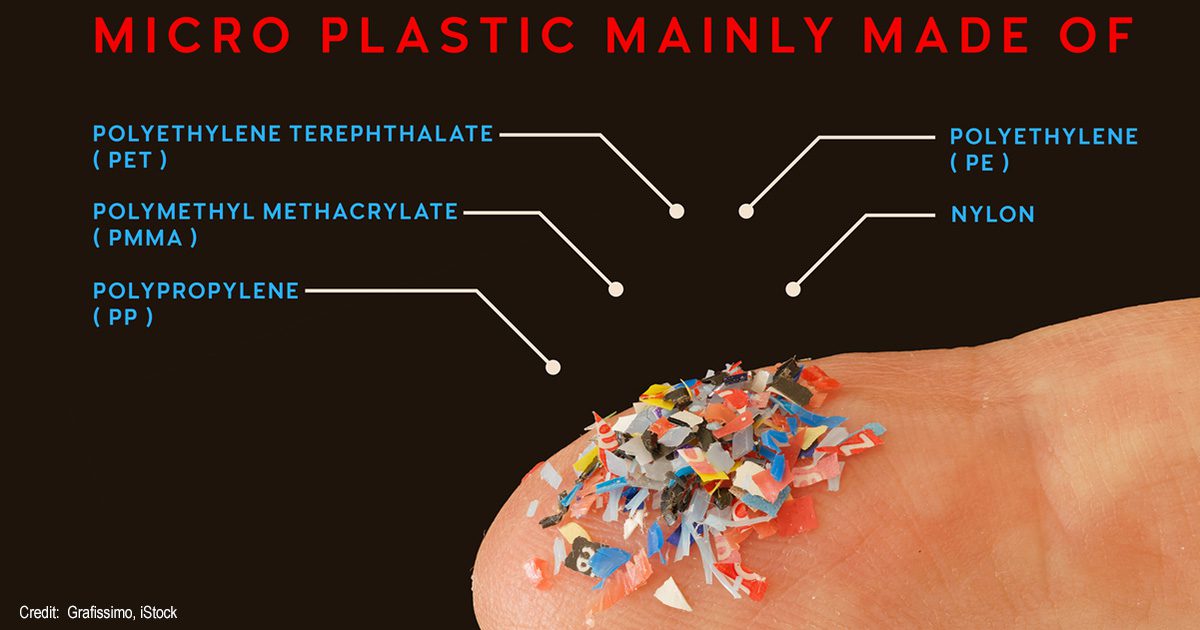
Polymers are a broad class of materials defined by their chemical structure, which contain long chains of repeating molecular units (monomers). Polymers can be natural, e.g., DNA, proteins, and cellulose, or synthetic, e.g., polyethylene, polyvinylchloride (PVC), and nylon. Microplastics and nanoplastics are size-based categories of plastic particles, all composed of polymers.
What are microplastics? Microplastics are typically defined by size and are usually less than 5 millimeters. Primary microplastics are manufactured small (e.g., microbeads, industrial pellets) while secondary microplastics are fragments formed from the breakdown of larger plastic items (bags, bottles, textiles, tires). Microplastics are always synthetic polymers, often with chemical additives, but their defining feature is their small size, not the polymer type.
Although there is no consensus on the size boundaries between microplastics and nanoplastics, many classify microplastics as smaller than 5 millimeters down to 1 micrometer (µm), while nanoplastics are usually defined as particles smaller than 1 micrometer (µm). Microplastics are usually visible to the naked eye, but nano-plastics are not.
The size difference between microplastics and nanoplastics is important because nanoplastics remain suspended in air and water longer and travel farther. They are harder to detect, quantify, and study. Microplastics typically remain in the digestive or respiratory tracts, but nanoplastics can cross cell membranes and biological barriers, such as the blood-brain barrier.