


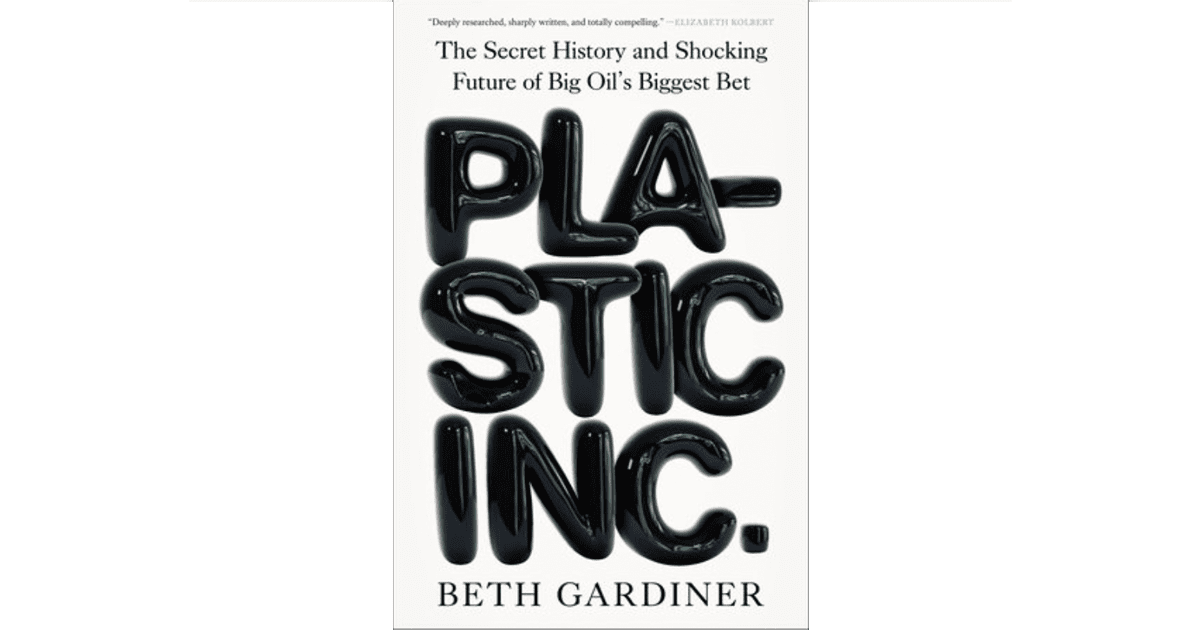
Apr 29, 2026 Book Review: “Plastics Inc.: The Secret History and Shocking Future of Big Oil’s Biggest Bet” by Beth Gardiner
Published by Penguin Random House
Plastics Inc.: The Secret History and Shocking Future of Big Oil’s Biggest Bet is a compelling new book by American journalist Beth Gardiner that explores Big Oil’s role in continuing to extract fossil fuels, which serve as the feedstock for ongoing and increasing plastic production. I expected Gardiner to reference the 1967 film “The Graduate,” particularly the scene where Mr. McGuire, played by Walter Brooke, offers career advice to recent graduate Benjamin Braddock, portrayed by Dustin Hoffman. McGuire’s advice is famously summed up in his statement: “I want to say one word to you—plastics!”
In 1967, plastic containers and packaging began to spread rapidly around the world. According to a brief history section on the website of the Plastic Shipping Container Institute, “the first plastic pails were produced and sold by Bennett Industries” that year, aiming to replace traditional packaging materials such as glass jars, metal pails, tins, steel drums, and corrugated boxes. The Institute’s history supports Gardiner’s analysis that there was little to no demand for plastic items until the industry created a supply.
Today, we see plastic packaging that is nearly impossible to open. John Kenneth Galbraith, a Harvard economist, criticized the excessive use of packaging in his 1958 book, The Affluent Society. In a humorous remark, he suggested that the ultimate goal of the packaging industry was to create an unopenable package. Galbraith argued that such excessive packaging demonstrated a lack of concern for consumer needs. Gardiner expands on this claim, asserting that both the plastics industry and Big Oil show a disregard for human and environmental health due to the increasing production of plastic from fossil fuels.
Annual plastic production has quadrupled since 1980, reaching approximately 460 million metric tons by 2025. This surge in production is primarily driven by the growing demand for plastic materials in the packaging, automotive, and construction sectors. Unfortunately, recycling rates remain dismally low, with less than 10% of plastic items recycled, despite the widely recognized triangle recycling logo on many plastic products.
The potential health impacts of micro- and nano-plastics are raising increasing global concern, as highlighted in a recent WBI newsletter. Microplastics originate from the breakdown of discarded plastic items scattered in the environment. They are widespread across the globe, with the Great Pacific Garbage Patch serving as a notable example. This patch contains approximately 100,000 tons of plastic spread over 620,000 square miles of the Pacific Ocean, with about 6 pounds (2.722 kgs) of plastic for every pound (.454 kgs) of plankton. A similar patch exists in the Atlantic Ocean. In 2016, the Ellen MacArthur Foundation released a report estimating that by 2050, there will be more plastic in the oceans than fish.
In March 2022, the United Nations Environment Assembly adopted a resolution to develop an international, legally binding treaty on plastic pollution by the end of 2024. However, by the end of 2024, no treaty had been produced. According to a December 5, 2025, article in Chemical and Engineering News, disagreements over potential treaty language have hindered the UN’s ability to produce a global agreement on plastic pollution.
Following the resignation of the first chair of the Intergovernmental Negotiating Committee (INC) on plastics after six meetings to generate treaty language, a new chair, Julio Jordano of Chile, was appointed. In the first four months of 2026, he distributed three letters to INC members, revitalizing the possibility of producing a global treaty. The Ellen MacArthur Foundation emphasizes that the new treaty must provide clarity on how to transform the entire plastics system in ways that benefit the planet, people, and businesses worldwide. This new system should aim to establish market stability and resilience through effective circular economy solutions. (See WBN – A Circular Economy and “Feel Better”)
In her book, Gardiner consistently highlights that the plastics industry has crafted the idea of recycling to shift responsibility for plastic pollution onto individual consumers rather than holding corporations that produce and use plastics accountable. She points out that plastic pollution primarily stems from supply issues. The demand for plastic materials arises directly from the production and availability of vast quantities of inexpensive, easily disposable plastic products. Unfortunately, recycling these materials is often ineffective, partly because new plastic items are so cheap to manufacture while recycled products are more expensive.
The rising production and availability of plastics have led to an accumulation of microplastics in the brains of people who have died more recently. The health consequences of these pollutants are not yet fully understood, but there are concerns about how microplastics in brain tissue may affect cognition. More research is needed.
I am hesitant to predict that Gardiner’s book will achieve the same level of recognition for its cumulative impact as Rachel Carson’s, Silent Spring (which launched the environmental movement), Peter Singer’s Animal Liberation (which initiated the animal rights movement), or Ruth Harrison’s Animal Machines (which started the field of animal welfare science with a focus on farmed animal welfare). However, I can assert that it deserves to have a similar impact!