


Jul 15, 2026 Plastic Progress or Plastic Paralysis?
Introduction: A World Drowning in Plastic
A global consensus recognizes that plastic pollution is a major issue, yet that consensus does not extend to whether the solution lies in reducing global plastic production or improving plastic waste management. WellBeing International, Inc. has published eight newsletter articles aimed at raising awareness of this issue, including a recent book review of “Plastics Inc.,” which provides extensive documentation of the corporate drivers behind plastic production.
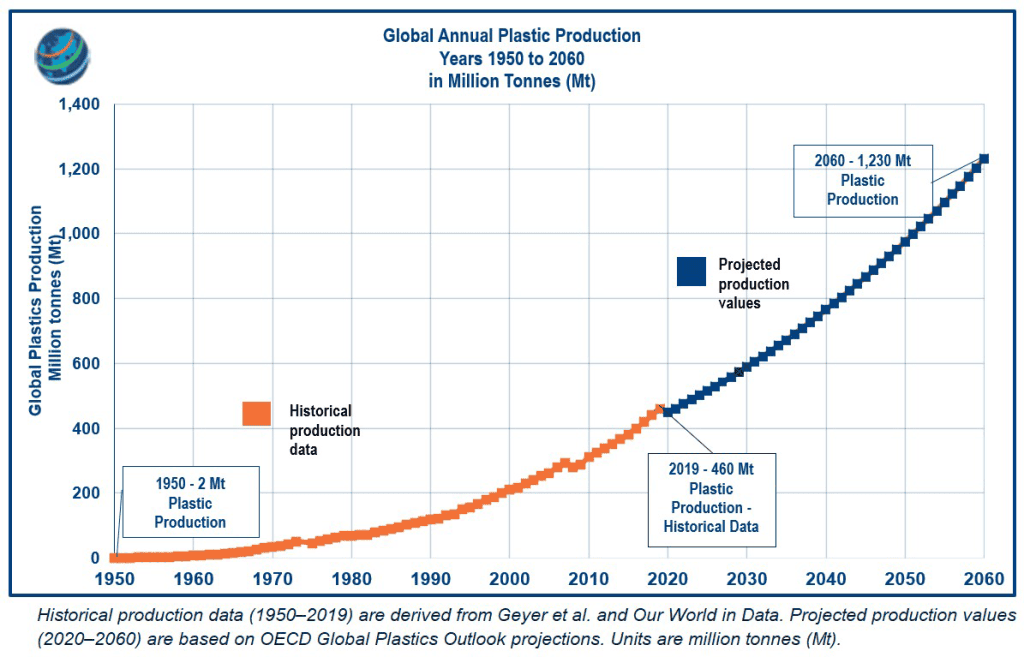
How significant has the increase in plastic production been since the early 1950s? As the chart illustrates, plastic production began at 2 million tonnes (Mt) in 1950, marking the start of the plastics revolution. By 2019, plastic production had soared to 459 Mt, and projections for 2060 suggest it will rise to 1,230 Mt.¹ These figures highlight the scale of the plastic challenge we are facing and raise concerns about whether our current mitigation strategies are sufficient.
Plastic waste matters as well, and analyses of what happens after plastics are used can be a more direct link to environmental degradation. After all, not all plastics produced generate pollution. As reported by the OECD, global plastic production was approximately 460 Mt in 2019, while plastic waste generated was 353 Mt for the same period (Global Plastics Outlook: Economic Drivers, Environmental Impacts and Policy Options (OECD Publishing, Paris). According to OECD data, after accounting for losses during processing and recycling, 9% of plastic waste was ultimately recycled, 19% was incinerated, nearly 50% was landfilled, and the remaining 22% was disposed of in uncontrolled dumpsites, openly burned, or leaked into the environment. Percentages shown in the figure are based on OECD estimates for 2019.²
It has been estimated that the world has produced a total of 9.5 billion tonnes (or gigatonnes – Gt) of plastic since the start of the plastics revolution, much of which is now in landfills, waterways, and the natural environment.³
In response to the broad global consensus that plastic pollution is an urgent problem, the UN, represented by the United Nations Environment Program (UNEP), has been negotiating a global plastics treaty since 2022. However, no agreed text for an enforceable treaty has been produced yet.
The global response to plastic pollution is not keeping pace with the rapid increase in plastic production. Current efforts to recognize the problem, decide on necessary actions, and implement solutions have been insufficient to address the plastic pollution crisis. Consequently, waste management practices are struggling to keep up with the growing production of plastics.
The Good News: Some Strategies Are Working
Even in the absence of an agreed UN global plastics treaty, there are effective programs and approaches delivering impressive results as described in the examples below.
The Plastic Pact Network, developed by the Waste Resources Action Programme (WRAP), a nonprofit organization launched in 2000, and the Ellen MacArthur Foundation, operates in 19 countries worldwide and currently engages over 900 local and global organizations.
The 2024 UK Impact Report produced by WRAP notes that, since 2018, the UK Plastic Pact Network activities have resulted in:
- 850,000 tonnes of plastic packaging redesigned to be reusable, recyclable or compostable.
- 430,000 tonnes of plastic packaging recycled.
- 360,000 tonnes of problematic and unnecessary plastics eliminated; and
- 2,200,000 tonnes of new virgin plastic production avoided.
Successful approaches to deal with the challenge of plastic pollution currently include:
Deposit return systems, where consumers pay a small deposit on beverage containers. The deposit is returned when the containers are brought to a return point (implemented in Germany, Norway, Canada and certain US states). Such initiatives reduce plastic litter, improve recycling streams and have been effective.
Extended Producer Responsibility, where manufacturers pay for the collection, sorting, recycling and disposal of used plastics (almost 700 initiatives in 85 countries). Such initiatives include product redesign incentives, improved collection and recycling procedures, traceability, and the development of markets for recycled materials.
Bans on specific plastic items such as single-use bags, straws, cutlery, hotel toiletries and polystyrene containers (over 130 countries have implemented some form of a ban on single-use plastic items). However, the ban in India (2016, amended in 2021) illustrates how a lack of enforcement and education reduces the overall impact of such legislative initiatives.
The Ellen MacArthur Foundation continues to emphasize the importance of creating a practical and functioning circular economy for plastics. For more information on the circular economy, please refer to WBI’s newsletter.
While these are encouraging trends, they must be viewed in the context of global plastic production in 2024, which totaled 430.9 million tonnes, with 90% virgin plastic. While plastic recycling rates are improving, they are still not growing fast enough to reduce the amount of new plastic entering the environment every year. Plastic producers widely promote recycling as a technological solution to the growth of plastic production. However, recycled plastic is more expensive to produce, and recycling degrades the properties of recycled plastic items.
The Reality Check:
Why Recycling Alone Cannot Save Us
Although plastic recycling rates are rising, the production of new virgin plastic items is increasing even faster. Additionally, producing recycled plastic products is often more expensive, and recycled plastics are not usually as versatile as new virgin plastic products. Consequently, recycling is currently lagging behind the production of new plastic. Nevertheless, recycling, along with redesigning plastic products to enhance their recyclability and compostability, should remain an important part of strategies to reduce plastic waste in the environment.
Plastic Waste Generated & Recycled and Outcomes
As noted earlier, the increase in plastic production has generated considerable interest. Likewise, the production of plastic waste is also a concern. There are three main managed outcomes for plastic waste: recycling, incineration and consignment to a landfill. If there is no regular municipal waste collection and disposal, then waste is usually categorized as mismanaged. According to OECD data, 353 Mt of plastic waste were generated in 2019, while only approximately 32 Mt were recycled.² Typically, waste is relatively well managed in high-income countries, even though most of it ends up in landfills. Much mismanaged plastic waste ends up in streams and rivers, and eventually in the ocean. Managed waste services provide a structured process for dealing with waste and help businesses and municipal services reduce their environmental footprints.

Other Areas of Concern
Meanwhile, ocean cleanup projects, chemical recycling of plastics and the development of recyclable bioplastics have not yet evolved into effective approaches for reducing plastic pollution. Preventing plastic from entering the ocean in the first place is typically cheaper and more effective than ocean clean-up efforts, and ocean clean-up projects cannot effectively address microplastic pollution.
A switch to bioplastics is also unlikely to have a major impact on plastic pollution. There is no standardized definition of a “bioplastic.” The term may refer to items made from plant material or to items supposedly biodegradable. However, biodegradability is rarely defined, while plastics made from plant materials are likely to include chemicals of unknown toxicity that enhance the properties of such “bioplastic” products.
Preliminary data on the human health impacts of microplastic and nanoplastic particles detected in most human tissues include some worrying findings. For example, the presence of tiny plastic particles in the human brain and heart is linked to increased rates of cognitive and cardiovascular health problems. There is also a possibility that the average 50% decline in male sperm counts since 1980 may be due to increased exposure to plastic chemicals or particles.

Are Plastics Becoming the Next Climate Change?
According to WellBeing International’s newsletter on COP30: Follow-up & Outcomes, “It has become clear from recent COP meetings that achieving consensus on contentious issues among nearly 200 countries is a daunting task.” This challenge has also been evident in the recent negotiations surrounding the proposed UN Global Plastics Treaty. Launched in 2022, this treaty initiative aims to establish a legally binding international agreement. Completion of the treaty was anticipated by 2024, but two years later, there is still no agreed text.
Similar to the negotiations for the UN Framework Convention on Climate Change (UNFCCC), the UN Global Plastics Treaty also faces several obstacles, including the influence of fossil fuel interests, the massive economic footprint of plastics, the challenges of consensus decision-making, and debates over whether to focus on limiting virgin plastic production versus prioritizing recycling, better waste management, and new, untested technologies.
In addition, discussions surrounding the plastics treaty have reflected structural features commonly seen in international climate agreements for decades—such as successive conferences, evolving draft texts, proposals for reporting and financing, and a commitment to consensus-based decision-making. The question is whether we are expending more resources on treaty processes and not enough on implementing practical, readily available solutions showcased by the various Plastic Pact Networks.
Important Differences Between Plastics and Climate Change Challenges
Importantly, unlike climate change, many effective solutions to reduce plastic pollution can be implemented immediately by countries, states, municipalities, businesses, and consumers without waiting for a global treaty. However, measures that require coordinated international action—such as global production caps, reporting requirements, common standards, financing mechanisms, and collective reduction targets—would be much more difficult to achieve without an international plastics treaty.
WBI believes that the narrower focus of plastics initiatives compared to broader climate change efforts allows for more organic development at the community, municipal, state, business, and consumer levels. Focusing on specific issues, such as plastics, may make it easier to implement effective initiatives. In fact, addressing climate change might benefit from breaking down its initiatives into smaller, more manageable policy issues to expedite treaty negotiations and implementation.
What Should Success Look Like?
The various Plastic Pact Networks illustrate what success in addressing plastic pollution could look like. First, unnecessary plastic items should be eliminated from production lines. These would mostly be single-use items that are used and immediately discarded. Second, product lines should be carefully re-examined to determine how plastic items might be redesigned to be more recyclable or eliminated. Third, better waste collection systems must be developed and implemented globally to reduce the amount of plastic waste entering the world’s oceans. Fourth, the world needs to slow the growth of virgin plastic products produced and increase recycling rates. Finally, a global treaty that focuses efforts on these outcomes and allows countries and corporations to agree on realistic plastic production targets and limits on plastic waste would be a positive development.
Conclusion
While the world is improving its management of plastic waste, it is also producing plastic at an increasing rate. Effective initiatives to address plastic pollution include enhancing recycling infrastructure, promoting producer responsibility, developing more reusable systems, reducing unnecessary plastic usage, and slowing the growth of virgin plastic production. These strategies can help to curb the rise in both the production and consumption of plastics. Moving forward with implementing a globally agreed-upon plastics treaty would further support the sustainable production and use of plastics.
Image Credit: romaset, iStock
¹ Historical data (1950–2019) from Geyer, Jambeck, and Law (Science Advances, 2017), as compiled by Our World in Data. Projected values (2020–2060) are from the OECD Global Plastics Outlook: Policy Scenarios to 2060 business-as-usual scenario. Units are million tonnes (Mt). [ourworldindata.org], [Geyer et al 2017 | Word], [oecd.org]
² OECD (2022), Global Plastics Outlook: Economic Drivers, Environmental Impacts and Policy Options (OECD Publishing, Paris). The OECD reported that global plastics production reached 460 million metric tonnes in 2019 and generated 353 million metric tonnes of plastic waste. After accounting for losses during processing and recycling, 9% of plastic waste was ultimately recycled, 19% was incinerated, nearly 50% was landfilled, and the remaining 22% was disposed of in uncontrolled dumpsites, openly burned, or leaked into the environment.
3 Global plastics production data are obtained from Our World in Data for 1980–2015 and are based on Geyer, Jambeck, and Law, Production, Use, and Fate of All Plastics Ever Made (Science Advances, 2017). Global production data for 2016–2024 are based on Plastics Europe, Plastics – The Fast Facts 2025: Global and European Plastics Production and Economic Indicators 2024. The cumulative estimate of approximately 9.5 billion metric tonnes (gigatonnes – Gt) of plastics produced between 1950 and 2019 is provided by Our World in Data.