



Jul 29, 2026 Living with Coyotes: What Coexistence Really Requires
Across much of North America, coyotes have become increasingly visible neighbors. Once associated primarily with prairies, deserts, and rural landscapes, they are now common in suburbs, city parks, golf courses, and even densely populated urban neighborhoods. Their presence can inspire a range of reactions—from fascination and admiration to concern and fear. As more people encounter coyotes in their daily lives, communities are grappling with an important question: how can humans and coyotes safely share the same landscape?
For decades, many communities have relied on lethal control to reduce coyote populations and minimize conflicts. The U.S. Department of Agriculture kills approximately 60,000 coyotes annually to address livestock predation, and estimates suggest that roughly 400,000 coyotes are killed each year across the United States through a variety of methods. Yet despite this extensive killing, coyote populations have persisted and expanded into new areas. Coyotes are remarkably adaptable animals, capable of thriving in environments ranging from remote ranchlands to major metropolitan centers.
This resilience reflects more than simple survival. Coyotes are intelligent, opportunistic, and highly adaptable members of North America’s ecosystems. They readily adjust their behavior to changing conditions and often become more nocturnal in areas with heavy human activity. Their flexibility has allowed them to flourish even as many other wildlife species have struggled to adapt to urbanization.
As coyotes move into human-dominated landscapes, however, encounters become more frequent. Most interactions are harmless sightings, but some can generate concern among residents, particularly when pets are involved or when coyotes exhibit unusually bold behavior. The challenge facing communities is not simply managing coyotes—it is managing the relationship between people and coyotes.
Understanding Human Attitudes
Human attitudes toward coyotes often reflect where people live and how they experience wildlife. Rural residents who experience livestock losses may view coyotes quite differently from suburban residents who encounter them on walking trails or in neighborhood parks. Even among urban communities, perceptions can vary significantly based on local experiences and management approaches.
A study examining coyote interactions in two neighboring Denver-area communities illustrates this complexity. Researchers reviewed hundreds of reports spanning several years and found that only a small percentage involved actual conflict. Most reports were simply sightings. The study also found that community management strategies and public education efforts influenced how residents perceived coyote presence and responded to encounters.
Similarly, researchers studying more than 9,000 reports of human-coyote interactions in Edmonton, Canada, found that both public concern and reports of coyote boldness increased over time. Importantly, the researchers concluded that human reactions are influenced by local context and that public concern does not necessarily diminish simply because coyotes become more common. Effective coexistence requires active communication, education, and management rather than assuming people will eventually become comfortable with the presence of coyotes.
Why Coexistence Matters
Many wildlife professionals now recognize that broad-scale efforts to eliminate coyotes are unlikely to succeed over the long term. Coyotes play important ecological roles, helping regulate populations of rodents, rabbits, and other small animals. In urban environments, they can contribute to ecological balance while providing natural control of certain pest species.
At the same time, coexistence does not mean ignoring legitimate concerns about public safety or pet safety. Rather, coexistence recognizes that people and wildlife share landscapes and that thoughtful management can reduce conflict while maintaining healthy ecosystems. Successful coexistence requires proactive human behavior, community engagement, and science-based policies.
What Coexistence Looks Like in Practice
One organization helping communities develop coexistence strategies is Project Coyote through its Coyote Friendly Communities program. Communities participating in these efforts typically focus on several practical measures:
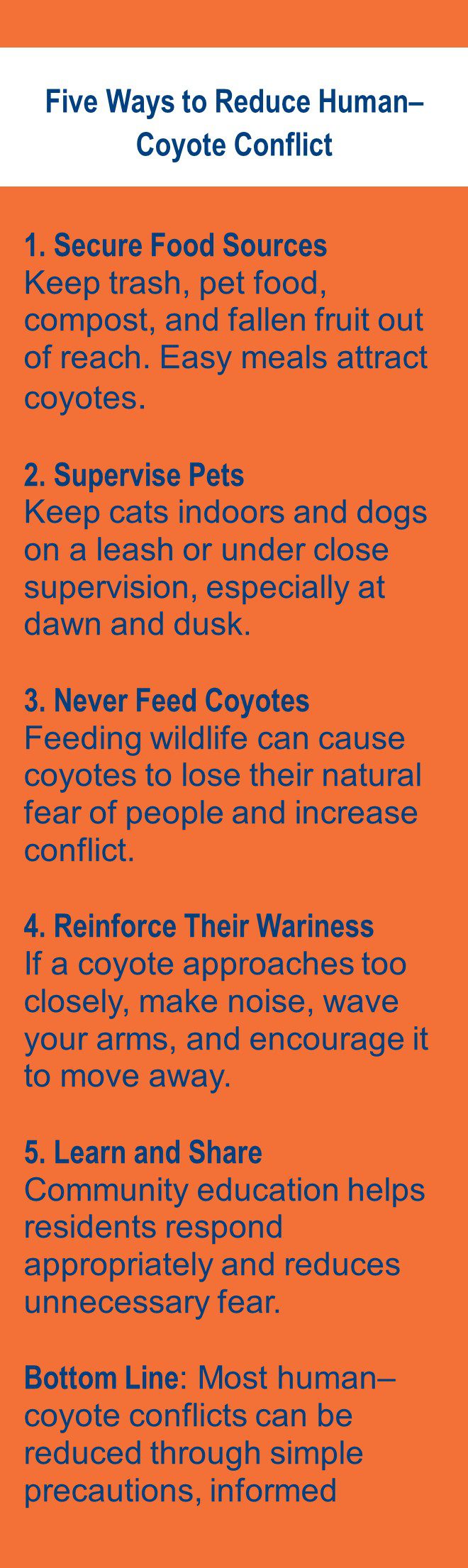
- Educating residents about coyote behavior and ecology.
- Reducing attractants such as unsecured trash, outdoor pet food, and compost.
- Encouraging responsible pet supervision.
- Providing educational signage in parks and neighborhoods.
- Teaching humane hazing techniques that reinforce coyotes’ natural wariness of people.
- Adopting science-based management policies that prioritize prevention and conflict reduction.
These recommendations closely mirror broader guidance developed by wildlife experts and coexistence plans across North America. Successful programs recognize that human behavior often plays an important role in creating conflicts. Feeding wildlife, leaving food sources accessible, or allowing pets to roam unattended can unintentionally attract coyotes and increase the likelihood of negative encounters.
Lessons from Southern California
A recent example comes from Baldwin Hills in Los Angeles. Community concern over coyote activity initially led some residents to consider hiring wildlife trappers to remove coyotes from the neighborhood. Instead, residents worked with Project Coyote and explored nonlethal management approaches focused on education and conflict prevention.
Culver City, a Baldwin Hills neighbor, commissioned a three-year study of coyotes and human-coyote conflict by the Center for Urban Resilience at Loyola Marymount University. The resulting report recommended a comprehensive approach that included public education, the reduction of attractants, responsible pet management, and a tiered response system to address conflicts. Rather than relying exclusively on lethal removal, the report emphasized matching management actions to the severity of the situation and improving community understanding of coyote behavior.
The researchers also noted that traditional lethal control can disrupt coyote social structures and territorial boundaries, potentially creating unintended ecological consequences. Their findings reinforce a growing recognition that long-term success often depends more on prevention and community engagement than on population reduction alone. However, Toronto’s experience with humane hazing raises questions about relying mainly on that approach.
A Shared Future
Coyotes are now a permanent part of many North American communities. The question facing cities and towns is not whether coyotes can be completely removed from the landscape, but how people can reduce conflict while maintaining safe and healthy communities.
Human-coyote coexistence is not a passive approach. It requires active public education, responsible pet care, reduction of attractants, careful monitoring, and science-based management. It also requires humans to recognize that both people and wildlife play roles in creating successful communities.
When communities invest in these approaches, coexistence becomes more than an ideal—it becomes a practical framework for reducing conflict, protecting companion animals, supporting ecological health, and helping people live more confidently alongside one of North America’s most adaptable wild neighbors.
Credit: akrassel-iStock