


Jul 10, 2025 Wild Horse Management and Protection
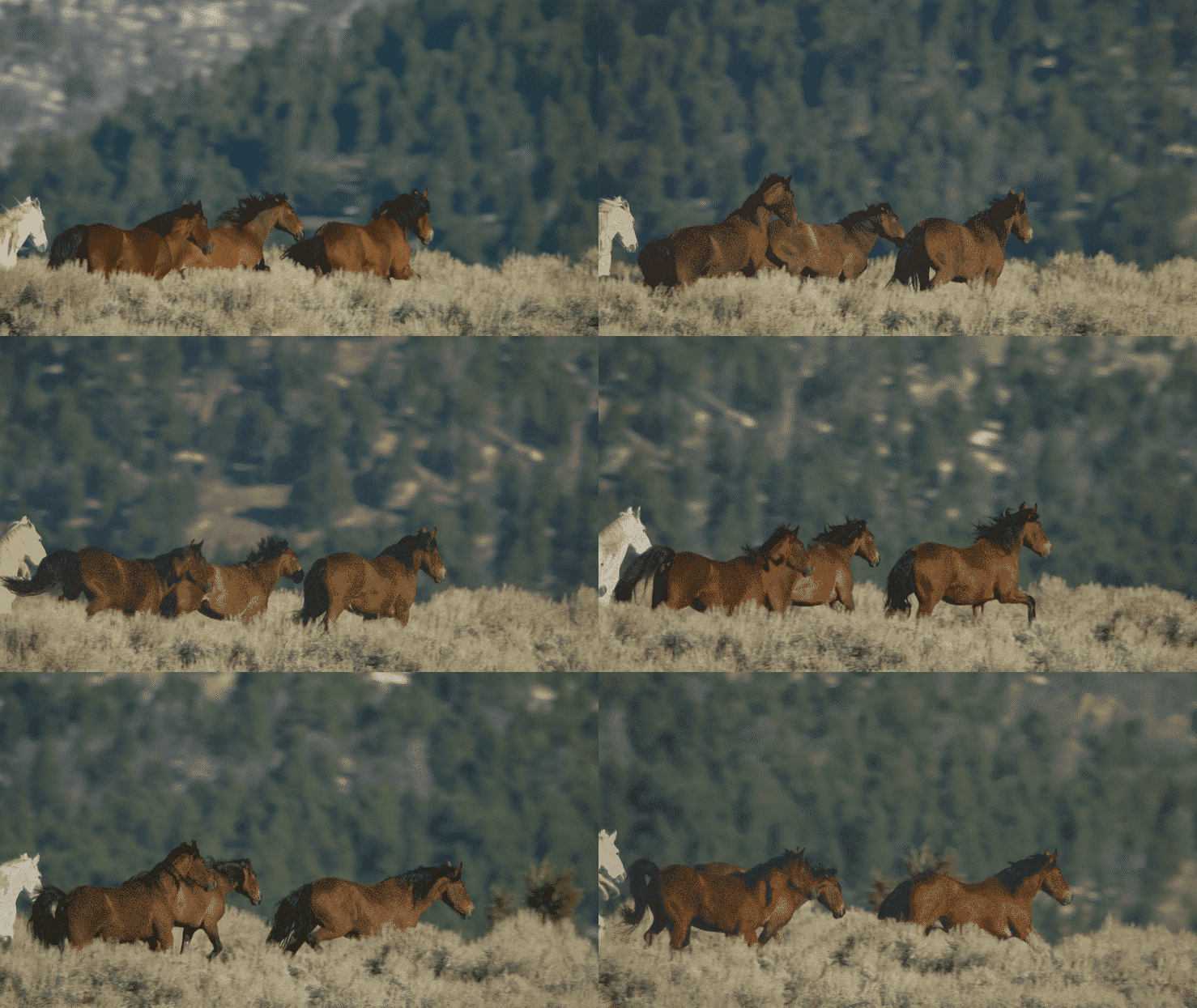
Wild horses draw considerable public attention and support. In Australia and the United States, they are regarded as symbols of the pioneer spirit that helped shape the settlement of these countries. Mrs. Velma Johnston, known as “Wild Horse Annie” from Reno, NV, effectively rallied public concern for wild horses starting in the 1950s. She initiated a letter-writing campaign directed at the U.S. Congress, ultimately resulting in the passage of the 1971 Wild Free-Roaming Horses and Burros Act. This legislation received unanimous approval in the House of Representatives and the Senate. The Act protects wild horses and burros by prohibiting their capture, branding, harassment, killing, and slaughter.
Since 1971, the Bureau of Land Management (BLM) has faced challenges balancing the competing mandates outlined in the 1971 Act. These mandates include protecting and managing wild horses and burros on public lands while ensuring a thriving ecological balance that considers the needs of wild horses, livestock, wildlife, and vegetation.
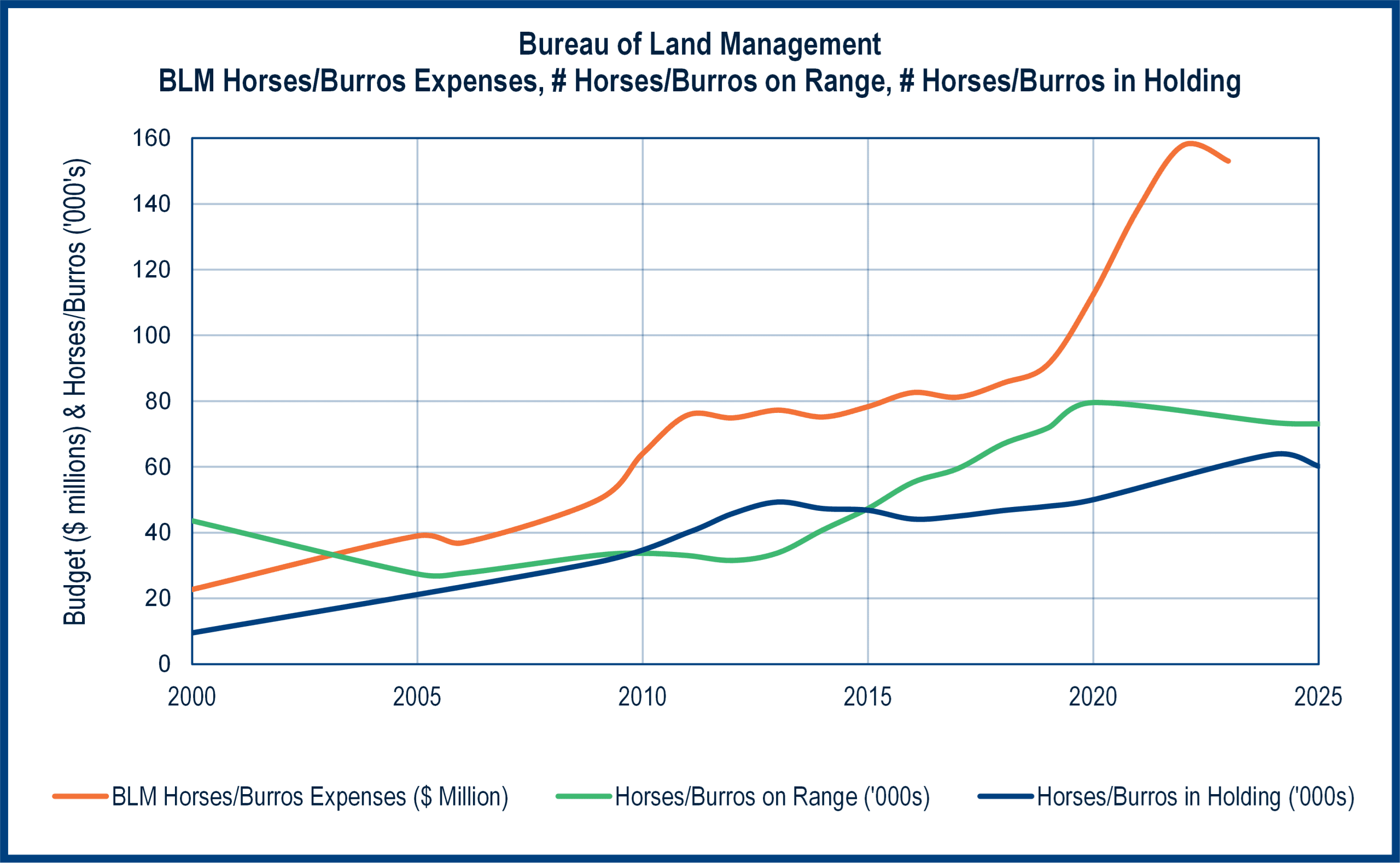
The BLM has designated 177 Herd Management Areas (HMAs) across 10 western states, covering approximately 128,000 square kilometers, about 1.3% of the total area of the United States. According to the BLM, these 177 HMAs can sustainably support around 27,000 horses and burros. This population level was only achieved in 2005 and 2006. Currently, there are approximately 73,000 wild horses and burros within these HMAs. (Please refer to chart below.)
Horse advocates are very concerned about the absence of language prohibiting sending wild horses to slaughter in the One Big Beautiful Bill Act of 2025 (H.R.1). The American Wild Horse Conservation (AWHC) organization recently warned (in May 2025) that this budget could pave the way for the “massacre of 64,000 wild horses and burros.” Following the passage of the Burns Amendment in 2004, which allowed the Bureau of Land Management (BLM) to sell unadoptable “excess” wild horses at local sale yards and auctions, Congress has included provisions in annual appropriations bills that block the sale of wild horses and explicitly prohibit the use of federal funds to support their slaughter. However, such language is missing from the recent budget bill, which has raised alarms on the AWHC website.
What is the Answer for Wild Horse and Burro Management?
The current approach adopted by BLM is a classic example of Einstein’s parable, which states, “Insanity is doing the same thing over and over and expecting different results.” For more than fifty years, the BLM has managed horse populations in the same way: when there are too many horses, they are gathered and removed. However, this raises an important question: what should be done with the removed horses? Wild Horse Annie began her crusade after witnessing blood dripping from a horse trailer en route to a slaughter facility in Nevada. The American public has consistently protested against sending wild horses to slaughter, leading the BLM to store removed wild horses in holding facilities across the United States.
Since increasing horse mortality is not an acceptable public option for controlling horse populations, the alternative is to manage fertility. Unmanaged wild horse populations grow 10-15% or more annually. At a 15% rate of increase, an unmanaged wild horse population would double every five years!
Fortunately, the National Park Service has found an effective method for controlling horse fertility that enhances welfare. In the 1980s, Irwin Liu from the University of California, Davis, demonstrated that horse fertility could be managed using a vaccine made from porcine zona pellucida (PZP) protein. The zona pellucida is the outer coating of an oocyte, which is the female mammalian egg.
This vaccine has several advantageous properties. The amount required to contracept a horse is so small that it can be administered remotely using a dart shot from a dart gun. Additionally, the production cost of the vaccine is relatively low, at about $10 to $20 per dose. Also, because it is protein-based, the vaccine is not a concern for the food chain.
The vaccine prevents the egg from being fertilized by sperm. There is no evidence to suggest that it would interfere with normal endocrine functions or the social behavior of vaccinated horses.
In a landmark study demonstrating proof of principle, twenty-six wild mares on Assateague Island, managed by the National Park Service (NPS), were treated with the PZP vaccine. Eighteen mares received three doses, while eight were inoculated twice. All were dosed by darting, making capture and handling unnecessary. A year later, none of the treated mares produced foals, confirming that two sequential vaccine doses prevented fertility. Some mares were already pregnant when they received the vaccine, but they went on to deliver healthy foals, showing that the vaccine did not affect foal health or survival.
Half of the treated mares received a booster shot a year after the initial treatment, while half remained untreated. Only one of the mares that had been retreated produced a foal, whereas fifty percent of the untreated mares foaled. This is the normal rate of foaling. These results indicated that the vaccine treatment is reversible.
Due to the early findings, the NPS decided in 1994 to use the vaccine to manage the population of 166 ponies on Assateague Island, aiming to reduce the number to around 80 animals to prevent damage to the fragile barrier island ecosystem. All 74 untreated mares on the island received a single dose of the vaccine through darting in March 1994. By March 1995, six foals had been born, and after a formal environmental assessment was completed, selected mares received additional vaccinations.
Over time, the project also revealed significant welfare benefits for the horses. Young mares that became pregnant do not fully recover from early pregnancies due to suboptimal forage on Assateague, leading to an average lifespan for mares of around seven years. However, if pregnancy in these young mares was prevented for two to three years in the early stages of life, their average lifespan extended to twenty-one years. One exceptional mare lived for thirty-five years.
However, the increase in average lifespan meant that it took a decade or more for the Assateague pony population to begin to decline and approach the target level of around 80 individuals.
The NPS project on Assateague was a significant success and was more economical than the gather-and-remove approach used by the BLM. However, managers of wild horses on Western rangelands argued that wild horses in the West are very skittish, making it impossible to get close enough to dart them. These claims were undermined by the successful fertility control project initiated in the Pryor Mountains of south-central Montana and another project in the McCullough Peaks Herd Management Area, located west of Cody, Wyoming, which was implemented by the non-profit organization, Friends of a Legacy (FOAL). Also, the BLM should consider vaccinating all female wild horses captured during gathers. Any females that are released back onto the range would then be primed and would only need annual boosters to prevent foaling.
Research is ongoing to develop a multi-year vaccine formulation that can be administered in a single dose. At the same time, USDA scientists have created a different vaccine that disrupts reproductive function and also reduces horse fertility. Efforts should also continue to explore better delivery methods and microchipping to provide essential data leading to improved horse management.
Einstein would have probably enthusiastically approved the different approach based on fertility control to manage wild horse populations in the Western Herd Management Areas.
Video credit: viafilms, iStock