


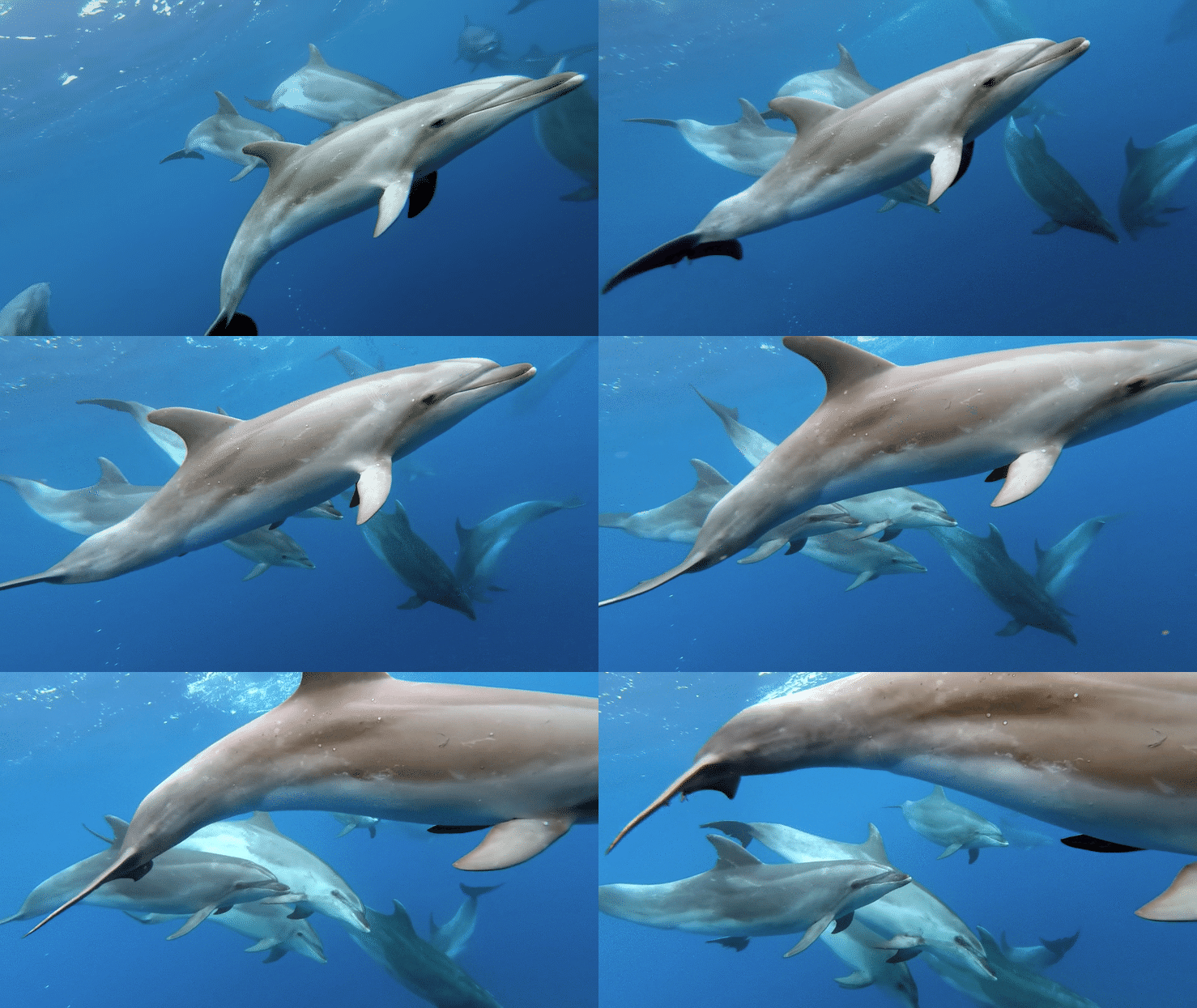
Jun 25, 2025 Wild Dolphin Project & Engaging with Dolphins
In 1985, Dr. Denise Herzing launched the Wild Dolphin Project (WDP) to study dolphins in the wild and identify their social structures and interactions. Dr. Herzing’s interest in knowing what dolphins might think began when she was just 12 years old. She chose to study the dolphins living around the Bahamas because the gin-clear water permitted easy observations of the dolphin pods and their social interactions. The WDP now has 40 years of data, videos and sound recordings of wild dolphins (Atlantic spotted dolphins – Stenella frontalis and bottlenose dolphins – Tursiops truncatus) behaving freely in nature. These data have become a treasure trove of insights into dolphin social interactions and family relationships.
The WDP can identify individual dolphins using unique markings and then develop family relationships using DNA extracted from fecal samples left in the water by identified individual dolphins. The WDP’s non-invasive research approach has allowed the team to build trust among the dolphin pods they study and, over four decades, develop a unique dataset of video and audio recordings carefully paired with individual dolphins, life histories, and observed behaviors.
In the late 1990s, the WDP team noticed that dolphins mimicked human behaviors. The WDP then developed a dolphin communication project and recruited Dr. Adam Pack from Hawaii. Dr. Pack had worked on dolphin communications and cognition with Dr. Lou Herman at the Kewalo Marine Mammal Laboratory.
According to WDP, dolphins make three types of sounds – whistles, that appear to function as the names of individual dolphins and that allow family members to reunite, burst pulse “squawks” that are often heard during fights, and “buzzes” (a burst of clicks) that are often heard during dolphin courtship or when chasing sharks. Google is now partnering with WDP and with a Georgia Tech team to make progress on DolphinGemma, an AI model trained to learn the structure of dolphin vocalizations and generate novel dolphin-like sound sequences.
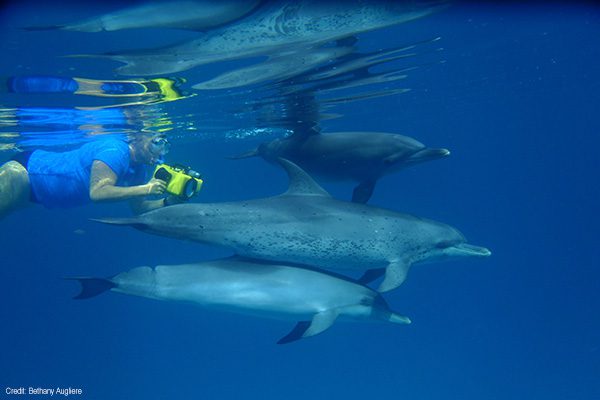
Denise Herzing with Atlantic Spotted dolphins and underwater video camera in the Bahamas. Wild Dolphin Project, Photo credit: Bethany Augliere.
Denize Herzing had reached out to Dr. Thad Starner and his group at Georgia Tech to develop a wearable device – the Cetacean Hearing Augmentation Telemetry device, or CHAT, that can produce sounds in the water. For example, Dr. Herzing now has her own whistle “name” that she can produce using CHAT. The CHAT device creates other synthetic sounds that refer specifically to the objects the humans bring with them (e.g., scarves and pieces of rope as toys for the dolphins). It is hoped that the dolphins will replicate these sounds when asking for or playing with the objects. In real life, dolphins play with pieces of seaweed, so the “toys” provided by the WDP team are eco-appropriate substitutes.
The CHAT device is powered by a Google phone that handles the high-fidelity analysis of dolphin sounds in real time. The new generation CHAT device, powered by a Pixel 9 phone, uses the phone’s advanced processing to run both deep learning models and template matching algorithms simultaneously. The use of Pixel smartphones reduces the need for custom hardware, reduces costs and increases the speed of human responses, making human-dolphin interactions more fluid and reinforcing.
Another challenge for the WDP dolphin communication project was identifying which dolphin made specific sounds underwater. Humans cannot tell where sounds originate when underwater and cannot even hear some of the sounds the dolphins make. Dr. Herzing reached out to acoustics expert Dr. Matthias Hoffman-Kuhnt of the National University of Singapore, who developed a device for snorkelers to use. It had three hydrophones to establish the origin of a specific sound and a video camera that would locate which dolphin was making a particular sound and videotape the dolphin’s behavior. Dr. Herzing said she “wanted this tool thirty years ago but could not find anybody who knew how to build it.”
Dr. Herzing is determined to crack the puzzle of dolphin communication, and Dr. Adam Pack says that she has done an amazing job of developing the team that is now investigating dolphin communication. In a Changing Seas video, Dr. Herzing says human language involves recombining sounds to produce words. “We don’t know if dolphins do that. Nobody has looked at it before. No one has ever had a computer tool to do that.” With the explosion of interest and funding support in developing large language models to understand what animals are saying (e.g., the Earth Species Project), it is likely just a matter of time before someone becomes a real-life Dr. Dolittle.
Postscript: Dr. Elizabeth Anscombe, one of the most important philosophers of the 20th century, once remarked that if it were demonstrated that animals possess language, “we should have to redefine what we mean by language.” In her book, Intention, she argued that the expression of intention, especially through language, is a uniquely human, conventional act. The research undertaken by Dr. Herzing, her colleagues, and many others interested in understanding different animal species’ communications is truly revolutionary. Dr. Herzing is a 2008 Guggenheim Fellow and author of Dolphin Diaries and Dolphin Communication and Cognition, MIT Press.