


Oct 04, 2026 What Does the World Feel Like to Another Animal?
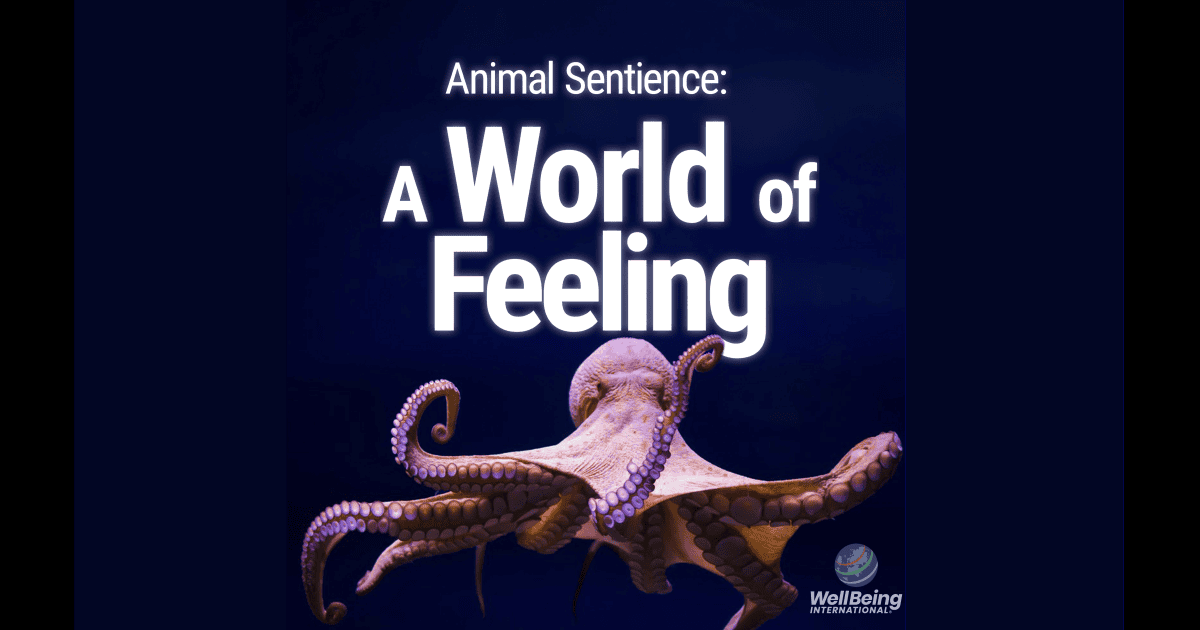
 A dog waits by the door for a human caretaker to return. An elephant remains close to a calf struggling to escape the thick mud at the edge of a waterhole. An octopus investigates an unfamiliar object. A fish moves away from perceived danger.
What might these animals be experiencing?
We cannot enter another being’s mind, whether that being is another person or another animal. Yet behavior, biology, and a growing body of scientific research offer important clues.
Sentience is the capacity to feel. It means having experiences that can be positive, negative, or neutral to the individual experiencing them. Sentience is not the same as intelligence or the ability to reason. An animal does not need to speak, calculate, or recognize itself in a mirror for its experiences to matter.
History offers a powerful warning about the consequences of overlooking another being’s experience, or sentience. For many years, a widespread medical belief held that newborn babies did not perceive pain as adults did. As a result, human newborns routinely underwent invasive surgical procedures without general anesthesia.¹
Evidence accumulated that newborns possess the anatomical and functional systems needed to respond to painful stimuli and that inadequate anesthesia during surgery produced substantial physiological stress. In a 1987 randomized controlled trial of premature infants undergoing surgery, the infants who did not receive fentanyl showed significantly greater hormonal stress responses and experienced more postoperative circulatory and metabolic complications than those who received it.¹ Read the study in The Lancet. This and related evidence helped transform medical understanding and practice regarding pain relief and anesthesia for newborn infants.
The neonatal story offers a profound lesson: the inability to describe an experience is not evidence that the experience does not exist.
Like preverbal human infants, animals cannot describe their experiences. But scientists are not left without evidence that they might be sentient. Researchers can investigate neuroanatomy, the biochemistry of nervous system activity, and overt behavior and choices, including responses to injury or threat, learning and memory, and responses to pain relief.
Because no single observation can settle the question, scientists consider multiple forms of evidence to determine which animals are sentient.² The feelings and other subjective states of animals can be investigated scientifically, even though they cannot be observed directly. Read the systematic review in Animals.
As Professor Stevan R. Harnad, Editor-in-Chief of WBI’s journal Animal Sentience, has emphasized, sentience is the capacity to feel, whether those feelings are positive, neutral, or negative, and includes the capacity to suffer.
We may not always interpret an animal’s experience correctly. But overlooking that experience can have serious consequences. If we mistakenly deny that an animal can experience pain or distress, we may fail to prevent unnecessary suffering. Scientific rigor remains essential, especially when the evidence is incomplete. But uncertainty should encourage careful attention rather than become a reason to dismiss what an animal may be experiencing.
Yet sentience is about more than suffering.
It is also about what can go well in an animal’s life.
Animal welfare science has traditionally focused heavily on reducing negative experiences such as pain, fear, and distress. Today, researchers increasingly recognize that animal welfare also involves positive experiences and rewarding activities.³ Thinking about sentience, therefore, encourages us to ask not only how suffering can be prevented, but also whether animals have opportunities for comfort, choice, exploration, companionship, and other pleasant experiences. Read about the 2020 Five Domains Model in Animals.
Every species encounters the world through its own body and senses. An animal’s experience need not resemble ours to be significant. These differences invite us to look more closely, question familiar assumptions, and remain open to what careful research may reveal.
This article marks the beginning of WBI’s Animal Sentience Public Engagement Project, and we warmly invite you to explore this world of feeling with us.
In WBI’s forthcoming podcast series, we will begin with the essentials: What do scientists mean by animal sentience? How is sentience different from intelligence? And how can we investigate and identify the presence of experiences that animals cannot describe in words?
From there, we will explore how scientists evaluate evidence of sentience and consider animals whose bodies, senses, and lives may be profoundly different from our own. The series will reach toward the frontiers of current knowledge, where important questions remain and simple answers may not yet be possible.
You do not need to be a scientist or philosopher to join this conversation. You need only be curious and willing to consider a fascinating possibility: that life may be experienced in far more varied ways than we once imagined. We hope you will listen, share the podcasts with others, and bring your own observations and questions to this growing global conversation.
A world of feeling is all around us. We invite you to explore that world with us.
🎧 Listen to the Podcast
🎥 Watch the Podcast
Endnotes
- K. J. S. Anand and P. R. Hickey, “Pain and Its Effects in the Human Neonate and Fetus,” New England Journal of Medicine 317 (1987): 1321–1329; K. J. S. Anand, W. G. Sippell, and A. Aynsley-Green, “Randomised Trial of Fentanyl Anaesthesia in Preterm Babies Undergoing Surgery,” The Lancet 329 (1987): 62–66. Read the study in The Lancet.
- Helen S. Proctor, Gemma Carder, and Amelia R. Cornish, “Searching for Animal Sentience: A Systematic Review of the Scientific Literature,” Animals 3 (2013): 882–906. Read the systematic review in Animals.
3. David J. Mellor, Ngaio J. Beausoleil, Katherine E. Littlewood, Andrew N. McLean, Paul D. McGreevy, Bidda Jones, and Cristina Wilkins, “The 2020 Five Domains Model: Including Human–Animal Interactions in Assessments of Animal Welfare,” Animals 10 (2020): 1870. Read the article in Animals.