


Jun 09, 2026 What We Don’t See on Our Plates: The Hidden Costs of Modern Farming
Modern agriculture has been very successful at delivering cheap food to dining room tables around the world, but there are growing concerns about some of the external costs associated with intensive agricultural systems. For example, no fewer than 11 journalists at the New York Times have been critical of intensive animal agriculture (e.g., Nicholas Kristof’s recent article), and both The Guardian and the online news source Vox have published numerous articles on the external costs of our modern food system. The following paragraphs summarize recent studies and reports on the external costs of modern food production.
Public Health Costs
The state of Iowa is dealing with an epidemic of cancer. While age-adjusted cancer rates are mostly falling across the USA, Iowa’s rate is rising and is rising faster than the five other states that also have rising cancer rates. A recent paper from Yale University reviewed cancer incidence data at the county level in Iowa, California and Texas and compared those rates with the county-level density of intensive farm operations in the three states. Higher exposures to intensive farm animal feeding operations were linked to higher cancer rates in all three states. While the study controlled for age differences across the comparison counties, the authors cautioned that its design limited causal inference. However, the results raised important concerns about potential health risks in communities near intensive farmed animal feeding operations.
Aside from cancer, the use of antimicrobials for animal growth promotion contributes to the global rise of antimicrobial-resistant pathogens. It was estimated that, in 2010, approximately 70% of all antimicrobials used globally (an extraordinary proportion) were fed to farmed animals. Antimicrobial-resistant infections led to an estimated one million human deaths from resistant infections every year from 1990 to 2021 and are projected to increase to almost 2 million deaths annually by 2050.
Pollination Costs
Natural pollination services are a critical component of global farming and food production. However, a recent paper in the journal Biological Conservation reviews what is known about global changes in insect biomass, their effects on pollination and their impact on food production. The authors report that they have compiled a comprehensive review of population changes across insect taxa in many different parts of the world. The review highlights the declines in insect populations that started early in the 20th century, accelerated in the 1950s and 1960s, and “attained alarming proportions globally over the last two decades.” The identified reasons for insect declines vary, but conversion of land for agriculture and its intensification are cited in one quarter of the reports. Urbanization, by contrast, is only cited as a reason in 11% of the reports. Major insect declines occurred when agricultural practices shifted from traditional, low-input farming practices to intensive, fertilized crop production characteristic of the Green Revolution. The recent widespread development and use of neonicotinoids and other new pesticides are also identified as important factors in insect declines across the globe.
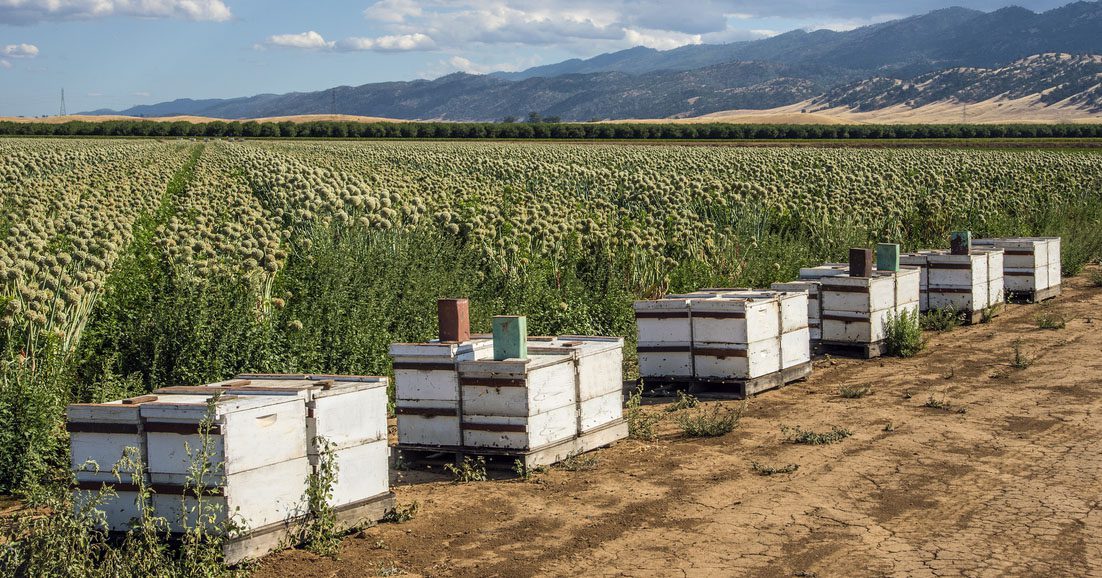
Beehives by onion field, Credit: CampPhoto, iStock
Costs Relating to Public Opinion, Democracy and Farmed Animal Welfare
The general public, whether in Europe or North America, has been strongly opposed to farming systems that confine animals in small cages for most of their lives. In October 2020, a European Citizens’ Initiative titled “End the Cage Age” presented to the European Commission the 1.4 million signatures collected from all EU member countries supporting the Initiative. This Citizens’ Initiative was only the 6th of 76 initiatives attempted since 2012 to have collected the required one million signatures from at least seven EU member states. The Initiative called on the EU to end the caging of farmed animals by 2027. To facilitate the transition, farmers would be provided with financial support, and the EU would require that animal product imports be restricted to those that met the new EU cage-free standards. Under pressure from agricultural interests, the European Commission has not yet proposed new legislation ending the caging of farmed animals. If the European Commission proposes new legislation, it becomes binding on EU countries only if that proposal is later adopted as EU law.
Across the Atlantic, in the USA, Massachusetts voters passed an anti-farm-animal-caging initiative by 78% in 2016, while California voters passed a similar initiative by 63% in 2018. The US pork industry filed lawsuits to block both initiatives. The lawsuits eventually reached the US Supreme Court, which declined to find in favor of the industry. Having failed at the ballot box and in the courts to make their case that gestation crates for female pigs were appropriate, the pork industry turned to the US Congress and asked it to pass the Save Our Bacon (SOB) Act as part of the Farm Bill, which is due to be renewed in 2026. The proposed SOB Act would block individual state laws that restrict how farmed animals are raised. It is somewhat ironic that animal welfare is one of the few issues where both the left and the right in current US politics are somewhat in agreement, and that Congress is now being asked to override the opinion of US voters in California and Massachusetts in favor of Smithfield Foods, Inc., the largest pork producer in the USA. Smithfield is an American company owned by a Chinese (Hong Kong–based) parent company.
Hidden Cost Estimates from the FAO Annual Report, The State of Food and Agriculture
The Food and Agriculture Organization (FAO) produces an annual report titled The State of Food and Agriculture. The 2023 FAO report noted that the hidden costs of global food systems exceeded $10 trillion, calculated at purchasing power parity in 2020. Unhealthy diets related to non-communicable diseases accounted for 70% of these hidden costs, resulting in $2.9 trillion in environmental damage. Nitrogen pollution from fertilizers and livestock waste is the single largest environmental cost. Climate change effects driven by livestock gas emissions, deforestation and energy use are another major component. Finally, the expansion of farmland into forests and natural habitats drives biodiversity loss.
The 2025 FAO report addresses land degradation and global farming parameters. According to the FAO, land degradation is a growing threat to agricultural productivity and ecosystem resilience. Around 1.7 billion people live in areas where crop yields are declining because of land degradation. The report notes that, of the 570 million farms worldwide, 85% are smaller than 2 hectares and, in total, cover just 9% of agricultural land. In contrast, farms larger than 1,000 hectares represent just 0.1% of the globe’s farms but manage half the world’s existing farmland.
The report offers some hope. Restoring croplands degraded by land degradation could reverse yield declines and support the livelihoods of hundreds of millions of farmers and their families, while restored croplands could feed hundreds of millions more people. The report also notes, as regards farmland ownership and gender equality, that “empowering women leads to better outcomes for households and ecosystems.”
Conclusions
Restoring the health of farming communities, addressing public health concerns, responding to public opinion on how farms are operated and how farmed animals are treated and reversing land degradation caused by farming intensification all lead to a wide range of benefits for people, animals and the environment. The question is no longer whether intensive agriculture works—but whether it works at a cost the world is willing to sustain. Our food system may look efficient, but that is only because the hidden environmental costs are “off the books.”
Video credit: wilpunt, iStock