



Jul 10, 2025 The Doggie in the Window: Regulating the Supply of Pets
The European Union (EU) and its earlier formations have played a significant role in developing animal welfare regulations and oversight since the 1970s. However, the EU has generally not addressed issues related to companion animal welfare, believing it is more effective for individual member countries to handle these concerns. The situation is similar in the United States, where state and local authorities are responsible for addressing companion animal welfare, rather than the federal government. Nonetheless, the European Commission is now proposing regulations to govern the trade in puppies and kittens. This proposal comes in response to reports highlighting serious welfare problems linked to the breeding and supply of these animals to meet the annual demand for companion animals in EU member countries.
An analysis conducted by staff from the European Commission reveals that EU countries have approximately 66 million pet dogs and 78 million pet cats. The annual trade in these animals amounts to around 1.3 billion euros and supports around 300,000 jobs. The analysis highlights that “Sub-standard breeding and illegal trade lead to important welfare and health problems for the dogs and cats concerned, as well as safety and well-being problems for the prospective pet owner.”
Additionally, there are considerable differences in the national regulations and standards governing dog and cat breeding establishments among EU member countries. Non-member countries, such as Russia and Ukraine, also play a significant role as major suppliers of puppies and kittens entering EU member states. For example, it is estimated that 50,000 dogs are brought into France illegally each year.
The staff analysis highlighted three key issues regarding illegal trade. First, commercial imports are frequently disguised as non-commercial activities. Second, the documents accompanying these illegal imports are often falsified, making traceability difficult or even impossible. Third, border agents often struggle to detect these falsifications, meaning they are usually uncovered only later, such as when a new pet owner takes their animal to the veterinarian for the first time.
The new EU regulations are designed to:
- Ensure a level playing field in the EU market regarding animal welfare rules and facilitate the smooth functioning of the internal market for dogs and cats.
- Improve the welfare of dogs and cats sold within the EU.
- Provide tools for monitoring and controlling fraud related to dog and cat sales in the EU.
The US and the EU are currently working to address welfare issues related to the supply of dogs and cats. For instance, when examining the market for puppies in the US, it is important to understand the demand for puppies in any given year. The American Veterinary Medical Association conducts surveys of the pet market in the US every five years. Since 1986, these surveys have been undertaken toward the end of the calendar year, asking respondents about the ages of the pets in their households. Any pet under one year old would most likely have been born and acquired by the household during the survey year.
As the data indicates, the supply of puppies needed to meet demand has declined by one-third over the past 30 years, dropping from 10.32 million in 1986 to 7.68 million in 2016. The supply of kittens required to satisfy demand has also decreased significantly, falling by 50% from 15.34 million to 7.59 million during the same period. See Table Below.
[Note: these numbers reflect only the demand for kittens by US households. They do not address supply issues – namely, the overall numbers of kittens produced in the USA, nor concerns about increases in kitten supply that may have occurred during the COVID pandemic shutdown and subsequent years.]
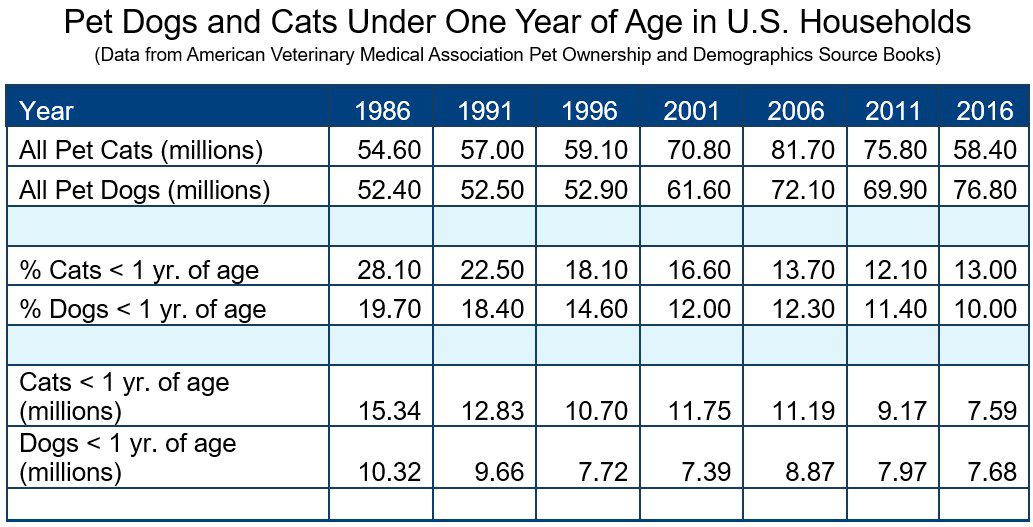
Despite significant criticism of individuals and companies that breed puppies and kittens for the pet market, there is surprisingly little information about the demand for these animals in the USA or the EU. The new regulation proposed by the European Commission is expected to provide valuable data regarding the dog and cat markets in the EU. In the USA, the Croney Research Group at Purdue University has been working on establishing standards for puppy and kitten breeding to address welfare issues and promote healthier pets. However, fostering constructive dialogue among various stakeholder groups has been challenging. With the European Commission’s new initiative on puppy and kitten breeding, welfare, and trade, there is a better opportunity for productive discussions that could lead to agreed humane approaches to meet the demand for pets.