


Aug 19, 2025 Great White Sharks in Film and Life
Fifty years ago, on June 20, Hollywood released a movie unlike any seen before. Jaws broke all existing box office records and launched the “summer blockbuster” trend. It was the first film to open in more than 400 theaters and the first to gross over $100 million at the box office, despite raising concerns because it exceeded its $7 million production budget. The movie also helped launch Steven Spielberg’s career. Spielberg was 27 when he directed Jaws and had just turned 28 before the premiere. Despite some gruesome scenes, the film received a PG rating, though parents were warned it might be too intense for younger children.
Professor Janet Davies at the University of Texas, Austin, argued that the American fear of sharks developed during World War II when service members were advised on what to do if they found themselves in “shark-infested waters.” A naval officer reported that fear of sharks was a leading cause of poor morale among service members in the Pacific theater. One of the worst wartime disasters in the Pacific occurred in July 1945 when the USS Indianapolis was torpedoed by a Japanese submarine. Of the crew of 1,196, around 900 survived the blast and landed in the water. As the survivors struggled to stay afloat, they watched in terror as sharks attacked dead and wounded shipmates. In Jaws, Quint, the grizzled shark hunter in the movie, said he had been on the Indianapolis when torpedoed and was one of about a third of the crew who survived. According to Professor Davis, the experiences of servicemen “played a pivotal role in creating an enduring cultural figure, the shark as a mindless spectral terror that can strike at any moment, a haunting artifact of World War II that primed Americans for the era of Jaws.”
Shark attacks happen around the world. The Florida Museum of Natural History has built a detailed and scientifically verified database of all known shark attacks. The International Shark Attack File records 6,800 cases from the early 1500s to today. It shows that Volusia County (with 359 attacks since 1882) and Brevard County (with 159 attacks since 1882) are the only two counties in Florida with over 100 shark attacks. Despite the high number of recorded attacks, there have been surprisingly few deaths. For example, since 2012, Volusia County has seen 94 shark attacks on swimmers, with no fatalities. Even bites from the three main species—white, tiger, and bull sharks—are deadly only about 25% of the time, with 124 out of 488 attacks being fatal.
Hooper, the marine biologist played by Richard Dreyfuss in Jaws, comments on how little is known about sharks. However, fifty years later, marine biology and tagged sharks have started to fill in the gaps. Great white abundance seems to be connected to the size of seal populations. As grey seals returned to waters around Cape Cod in Massachusetts, so did the number of great white shark sightings. The village of Amity in Jaws was a fictional community located on Martha’s Vineyard, an island off Cape Cod. Recently, Liberty, a young great white, was tagged with an underwater camera, which led researchers to a great white nursery off Long Island.
In the late twentieth century, shark cage diving became an exciting attraction in False Bay, just south of Cape Town. Seal Island, a small, uninhabited outcrop known for its abundant seal population, gained attention as a potential magnet for Great white sharks. It wasn’t until 1996 that these apex predators were first seen around Seal Island, leading to the start of several cage diving tours. Tourists, safely enclosed in sturdy metal cages, were lowered into False Bay’s waters for an exhilarating encounter with Great white sharks—majestic creatures often larger than ten feet.
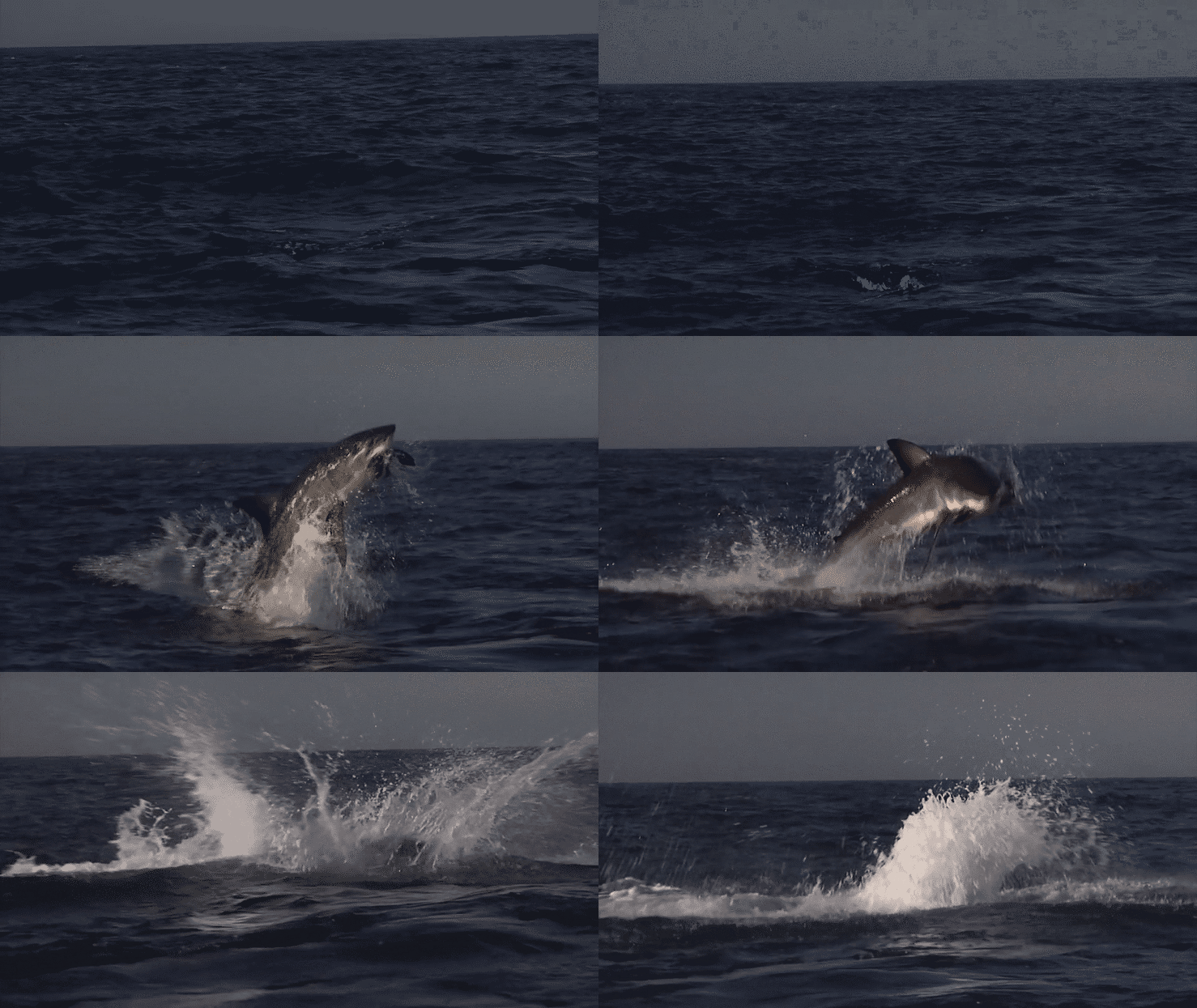
This phenomenon quickly spread along the South African coast, with cage diving operators also expanding to other regions. The traditional “Big Five” safari animals—lions, leopards, rhinoceroses, elephants, and Cape buffalo—were joined by the Great white shark, forming the famous “Big Six.” For many, witnessing a Great white breach the surface up close remains a genuinely unforgettable experience.
However, the Great white sharks have been disappearing from their usual habitats along the South African coast, and no one knows why. Several orcas recently appeared in False Bay, and their presence coincides with the disappearance of the Great whites. Orcas tear open a shark’s underbelly to extract the nutritious liver, and shark carcasses with their livers removed have washed up on beaches in South Africa. While orcas may have caused the decline of the Great whites in False Bay (none have been seen there since 2018), human fishermen might also have contributed to the decrease in white shark populations. Great whites produce few young, and removing even small numbers of adults could prevent the population from recovering.
A recent report on the impact of losing Great whites from False Bay discusses their role in the marine ecosystem. As Great white sightings dropped to zero, seal populations increased fivefold, and populations of the seven-gill shark, a prey species for Great whites, also grew. Scientists continually expand our understanding of Great white sharks and highlight the importance of such an apex predator for marine ecosystem health and stability.
Interested readers should look for the 50th anniversary release of Jaws on August 29. Moviegoers should be reassured that the rate of shark attacks in California (possibly related to declining shark populations) has decreased by 91% from 1950 to 2013, according to a 2015 Stanford University study.