


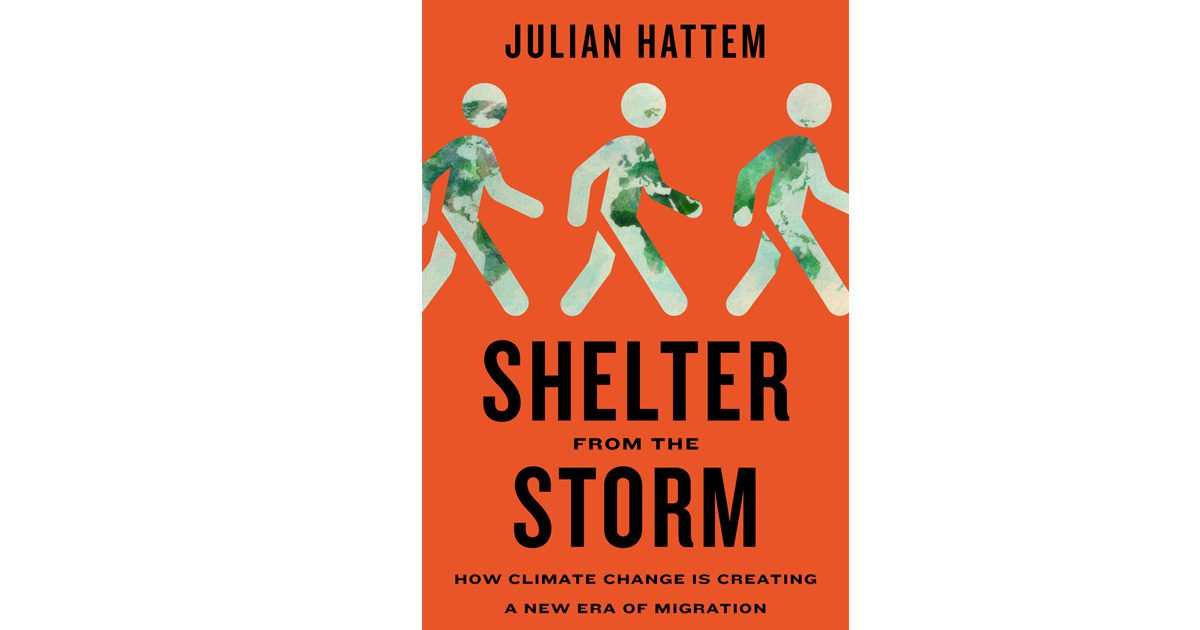
Mar 27, 2026 Book Review: “Shelter from the Storm” by Julian Hattem
In his new book, Shelter from the Storm: How Climate Change Is Creating a New Era of Migration (The New Press, 2026), Julian Hattem explores how climate and environmental changes are reshaping patterns of human mobility. He convincingly demonstrates that the scale of these migrations is likely to increase significantly in the coming decades. This book is one of the most comprehensive examinations of what is arguably the foremost crisis of our time: the mass migrations driven by climate change occurring worldwide.
He writes, “The age of climate migration has already begun. It will shape the century as profoundly as other types of migration in the early 20th century shaped that era, restructuring not just our demographics and economics but also the broader human geography.”
Hattem’s central thesis is that “we have always been climate migrants.” He argues that humans are an innately migratory species, and that environmental changes have historically spurred considerable human movement. According to him, migration is a fundamental human response to environmental stressors throughout history.
What is novel today is the unprecedented pace of climate change, which is forcing millions to migrate on a timescale that current political and social systems are unprepared to manage. His distinctive perspective views migration as necessary and “simply a reality of our time” requiring a fundamental rethinking of its role in society.
He debunks many myths regarding refugees and migrants: “A wide array of research has shown that immigrants do not commit crimes at higher rates than natives and the presence of refugees does not lead to more conflict.”
“The biggest migration problem may be that there is simply not enough of it. Making it easier for people to leave their home can not only help them flee the most dire disasters but also help them earn money to invest in an adaptation resilient strategy.” He points out that research shows walls do not “deter or prevent irregular migration in the long run although they may redirect it. There is a balloon-like nature to migration in that squeezing one end focuses the pressure elsewhere. People will generally continue to travel but they may do so through more remote and therefore dangerous crossings.”
The author makes his case while traveling to numerous countries, documenting the histories, adaptations, and personal vignettes of people he interviews. He highlights the gradual disappearance of Pacific nations as they are consumed by rising ocean levels. “One-third of the fifteen most climate-vulnerable countries in the world are located in the Pacific. … the only options are to leave or drown.” “In 2018, the remote East Island in northwestern Hawaii, the far-north Perlamutrovy Island off the Arctic coast of Russia, and …an island off the coast of Japan all disappeared, wiped off the map.”
The book begins with historical reviews of climate change events, such as the Little Ice Age (1300-1850) and the American Dust Bowl (1930-1936). The book then shifts to current issues such as the rising ocean levels affecting Bangladesh and the South Pacific. In Bangladesh, nearly ten million people are already considered “climate migrants” due to river erosion. On average, households in northwest Bangladesh have been displaced by river erosion 4.6 times. “About 10 million people in Bangladesh were considered to be climate migrants as of 2022”.
In Guatemala, the World Bank projects that nearly two million climate migrants will be on the move northward by 2050. Those trapped in “environmentally dying” lands, such as the drying farmlands of Guatemala, face the most severe impacts of climate change because they lack the resources to seek safety elsewhere. Hattem documents the devastating cultural erasure that occurs when communities, like the Munda people of Bangladesh, are scattered due to climate-induced displacement. He also visits and describes the shrinking of Lake Chad in central Africa, as well as refugees fleeing Burma into Bangladesh,
He explores how societies have coped with environmental and climate change. One example is Jakarta’s “Vertical Drains,” where the city shifted from large-scale engineering projects to installing 29,000 vertical drains that recharge aquifers. This approach also includes the use of sluices to temporarily store water during storms.
Another significant climate change project is the Maeslantkering in the Netherlands, a massive storm-surge barrier built after the devastating North Sea storm in 1953, which overwhelmed the country’s tidal defenses. This new storm surge defense is designed to withstand an event that is expected to occur once every 10,000 years. The Maeslantkering is cited as a successful example of large-scale engineering supported by the public and is a point of national pride.
“The generations old international refugee system is clearly failing, and we need a new framework.” One of the book’s most critical insights is the concept of “trapped populations.” Hattem argues that the biggest tragedy may not be that too many people are moving, but that many of the most vulnerable individuals cannot afford to move. He refers to the new international loss and damage fund created in 2023 to compensate people in countries affected by climate change damage, but notes that it is not clear who will benefit from the fund.
Climate migration will grow worse and worse, and Hattem makes it clear that “no one will be immune.” He draws parallels between disappearing islands in the Pacific and the flooding communities in the United States, arguing that the era of climate-driven relocation is already becoming a reality in wealthy nations. This requires a fundamental reevaluation of what “home” means in a warming world.
“A meta-analysis of 55 studies found that just one standard deviation increase in temperature increased the odds of conflict between groups by 11% and the odds of interpersonal conflict by 2%. Anthropometric climate change has the potential to substantially increase global violent crime, civil conflict, and political instability.”
Some changes are, he observes, “already locked in. Even if we got our carbon emissions under control tomorrow, there is a lag between warmer oceans and melting ice, meaning the seas will continue to rise for at least the next few decades no matter what mitigation measures we take. It is already too late.”
Hattem challenges the narrative that migration is solely a “crisis.” He highlights that leaving home can be a proactive adaptation strategy. The money (remittances) sent back by climate migrants enables families to adapt, rebuild and invest in their communities. “There is a pattern to where people move, and one key element is how much money they can expect to earn.” Additionally, he references the “remittance trap” where young people leave to earn money, often leaving their home countries without contributing to their development.
In recent years, many books have been written on this subject, but this one is perhaps the most approachable and easy to read, while also providing a balanced perspective. Hattem is uniquely qualified for his historical and global analysis, as he serves as editor of the Migration Information Source, the online publication of the Migration Policy Institute, a well-respected think tank in Washington, DC. However, Hattem asserts that the truly novel and distinctive aspect of the current era is the unprecedented pace of climate change, not migration itself.
Hattem also argues against claims that “mass waves” of migrants will flood the America and Europe. He notes the majority of climate-linked displacements occur internally or within regions (e.g., within Africa or South Asia). Overall, he argues that the real issue is not migration itself, but the lack of support for those who are forced to move, and for those who are trapped in increasingly uninhabitable environments.
The author is well positioned to guide the reader through the intricacies of migration causes and climate events. As editor of the Migration Information Source, Hattem oversees and contributes to content on global migration trends, policy, research, and emerging issues such as climate impacts. He has also been published in The Guardian, The Washington Post, The Atlantic, and The Hill. Additional publications on climate change and migration are available in a special issue of the Migration Information Resource.
Steven Hansch is a humanitarian aid specialist with extensive experience in fieldwork, management, and evaluation. He teaches at several universities and serves on several nonprofit boards involved in human development and humanitarian aid. Leslie Barcus has served on the boards of national and international animal protection organizations. Her professional activities include working in more than forty countries addressing animal protection, microfinance, biodiversity conservation, organizational capacity building, and international economic development.