


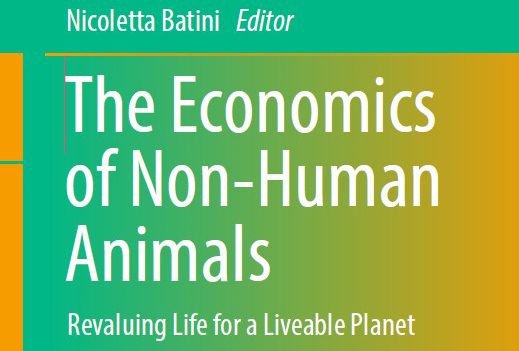
Jul 29, 2026 The Economics of Non-Human Animals: Revaluing Life for a Liveable Planet
This open-access book, published by Springer in 2026 and edited by Nicoletta Batini, is Volume 63 of the series Natural Resource Management and Policy. It includes twenty-one chapters covering themes from human economic symbiosis with other animals to human predatory (consumptive) uses of animals, including the use of animals in biomedical laboratories and for fashion, human “parasitic interactions” e.g., animals used in sports and transport, and human commensal uses of animals e.g., animals as human companions.
The book includes a Foreword by the Cambridge University economist, Professor Sir Partha Dasgupta, who highlights the importance of accounting for natural capital when assessing the wealth of nations. The topics covered in the book are too numerous and varied to address in a single review, and just two of the chapters, one on the biomedical use of animals by Dr. Thomas Hartung and another on valuing pets by Dr. Phillip Howell, will be covered, with a brief comment on a third chapter authored by Nicoletta Batini.
Professor Hartung, Director of the Johns Hopkins Center for Alternatives to Animal Testing (CAAT), is the perfect person to cover the chapter on “Animals in Biomedical Testing”, the economics of laboratory animal use and the accelerating global move to replace laboratory animals with New Approach Methods (NAMs). He notes that the NAMs sector is currently experiencing double-digit growth and was projected to reach close to $9 billion in value in 2022. He particularly emphasizes the promise of new Artificial Intelligence (AI) systems that have an extraordinary capacity to integrate and learn from vast, heterogeneous datasets, leading to improved predictive accuracy in chemical testing for human outcomes, 87% from the AI systems versus 81% for traditional animal tests. Crucially, he notes that the promise of AI lies not just in its predictive performance but also in its scalability, adaptability and interpretability. AI systems also produce results far faster than traditional animal tests. Nevertheless, the new AI-powered systems will need to be carefully developed to ensure that they are human-relevant, ethically grounded, globally inclusive and scientifically robust.
The chapter on companion animals (“pets”), “Animals as Pets”, is written by Dr. Philip Howell, Professor of Historical Geography at Cambridge University. Professor Howell notes that pets are a very big business. In the USA alone, the pet market is estimated at more than $150 billion annually, including $66 billion in pet food sales and $40 billion in veterinary services. Howell is appropriately skeptical about the accuracy of reported estimates of dog populations across countries and discusses in some detail the difference between the traditional economic value, how much was paid to acquire the pet, and the pet’s substantial emotional value. Howell notes that pet theft, really dognapping and subsequent ransom, is on the rise, forcing owners to “put a price on their sentimental attachment to their pet animals.” The “irreplaceability of the pet is at the heart of the criminal business model” behind dognapping.
The book also includes chapters by Nicoletta Batini, the editor. One such chapter is on “Animals and Ecosystem Services”. This chapter supports the argument that animals play essential roles in advancing global sustainability. From pollination services provided by insects, birds, and bats to the carbon sinks provided by beavers and whales, animals contribute to food sustainability and the sequestration of carbon produced by the burning of fossil fuels. According to Batini, these services are not only “vital for ecological balance but also contribute significantly to economic activities and human well-being”.
Taken together, the chapters in this volume remind us that animals enrich our lives in ways that extend far beyond traditional economic measures. They contribute to scientific progress, provide companionship and emotional support, sustain ecosystems, and help maintain the natural processes upon which human societies depend. By encouraging readers to reconsider how animal value is defined and measured, this book offers an important contribution to ongoing discussions about sustainability, well-being, and our relationship with the more-than-human world.