


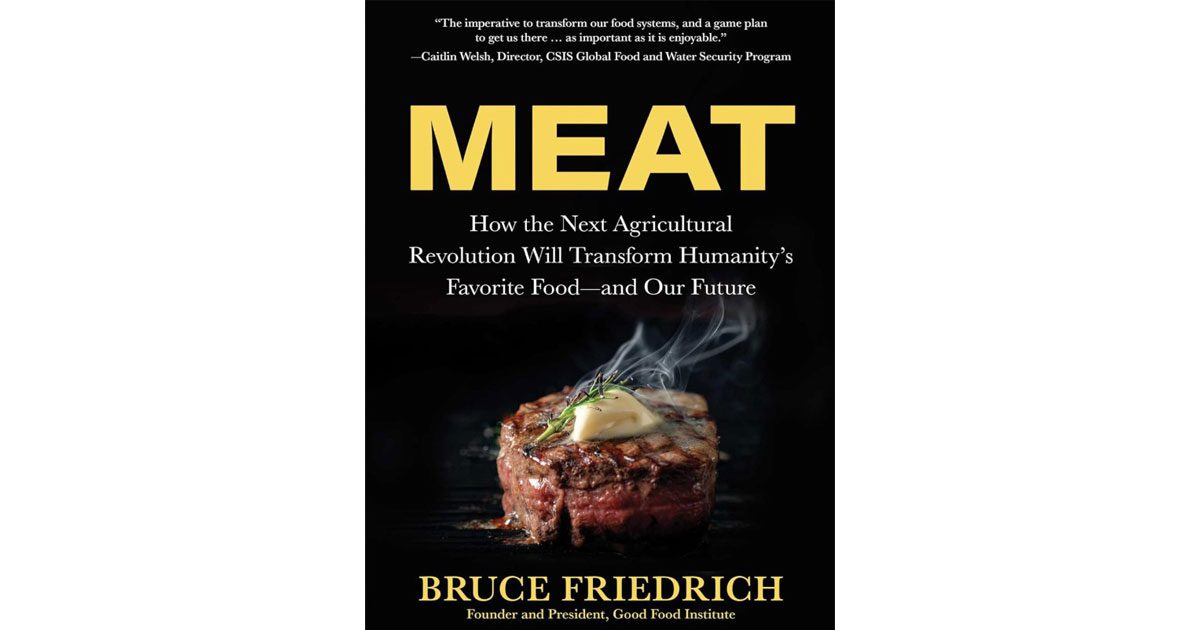
Feb 19, 2026 Book Review: “Meat” by Bruce Friedrich
In the early years of this century, I met Jason Matheny, an early advocate for cultured meat and the founder of the cultured meat company, New Harvest, in 2004. Matheny asserted that meat cultivated from the cells of cattle, pigs, chickens, and other farmed animals would evolve into a significant new technology, ultimately replacing meat from traditionally raised animals. At that time, I was skeptical of his claims. However, just over twenty years later, after reading Bruce Friedrich’s insightful book, Meat, which discusses alternative proteins and the potential of meat produced in bioreactors, I have changed my perspective and am no longer skeptical. Meanwhile, Matheny has shifted his focus to national security issues and currently serves as the CEO of the Rand Corporation.
Friedrich’s book is not the first comprehensive exploration of cultured meat. Paul Shapiro, a former colleague and advocate for animals at the Humane Society of the U.S. (now known as Humane World for Animals), published “Clean Meat” (Simon and Schuster) in January 2018. However, Shapiro’s focus was on the history and stories of the early pioneers in cultured meat technology, highlighting their efforts to secure funding and support for new companies producing and selling cultured meat. In contrast, Friedrich, who founded the Good Food Institute in 2016, approaches the topic as a food security issue while also addressing the challenges of how best to support and develop this promising new technology.
Many media stories have highlighted the significant amounts of venture capital flowing into early cultured meat and alternative protein companies. However, these optimistic reports have often been followed by negative accounts of struggling companies and unsatisfactory products. Despite recent failures in the cultured meat sector, Friedrich remains unfazed. He points out that at the end of the 19th century, about 500 companies were competing to produce cars for the public. Nearly all of these companies failed, some spectacularly. Still, a few succeeded in creating thousands of cars that the public eagerly purchased once issues related to pricing, quality, and infrastructure were effectively addressed.
Additionally, the early automobile industry addressed significant animal welfare and hygiene issues, particularly the treatment of horses and the management of their manure, arising from the transportation of people and goods in American cities at the time. This is a classic example of how technology can enhance animal well-being while also significantly improving human hygiene and disease prevention.
Friedrich observes that a similar transformation could occur for farmed animals as new cultured meat companies overcome the challenges of taste, cost, and production scale. New (or existing food) commercial companies could produce meat products that, as Google CEO Eric Schmidt stated in April 2016, would replace the “incredibly inefficient process of cycling crops through animals” while allowing us to “grow real animal meat, no animal required.” Friedrich argues that if cultured meat becomes a viable consumer product, it could help resolve national security issues while also addressing threats to food security, human health, climate change, global pollution, and biodiversity.
The Good Food Institute addressed the cultured meat challenge by commissioning Caitlin Welsh, the Director of the Global Food Security program at the Center for Strategic and International Studies, to analyze the food security challenges posed by both conventional and alternative protein production. In her report, Welsh highlights the potential of alternative protein products to help alleviate food insecurity worldwide. She predicts that the alternative protein market could expand from $1.4 billion in 2022 to $290 billion by 2035. Furthermore, Friedrich highlights additional benefits of cultured meat, including a reduction in global warming, the mitigation of significant global health threats (such as the rise in antimicrobial resistance and the potential for pandemics linked to traditional animal agriculture), safeguarding fresh water supplies, and allowing biodiversity to recover by letting some of the land currently used for conventional animal agriculture to revert to nature.
The Good Food Institute (GFI) also aims to create and support an academic ecosystem that fosters the successful development of cellular agriculture. Recently, GFI acquired scalable cell lines from several cultivated meat start-ups that have either closed or downsized and donated these lines to the Tufts University Center for Cellular Agriculture. This center was initially established in 2021 with a $10 million grant from the USDA and received an additional $2.1 million grant from the Massachusetts Technology Collaborative three years later. With the support of the Tufts initiative, Massachusetts is positioning itself alongside California, Singapore, and Israel as a global hub for research, development, and commercialization in cellular agriculture.
In his book, Friedrich explains how the Good Food Institute (GFI) is advancing cellular agriculture by promoting new research, identifying and educating future industry leaders, and supporting the field by producing in-depth reports on global developments. The organization also engages with national governments to encourage their support for and investment in cellular agriculture while addressing regulatory challenges.
GFI is promoting a compelling vision: a world where global greenhouse gas emissions decrease and healthy proteins are produced and consumed without contributing to the existential planetary risk posed by an expanding ecosystem of antibiotic-resistant microbes. Friedrich clearly explains how the successful implementation of cellular agriculture will benefit not only humans and animals but also the planet as a whole.
WellBeing International shares Friedrich’s concern about the insufficient actions taken to address the growing global issue of antimicrobial resistance. This problem is closely linked to the use of antimicrobials in animal agriculture, where they are often used to promote the productivity of farmed animals.