


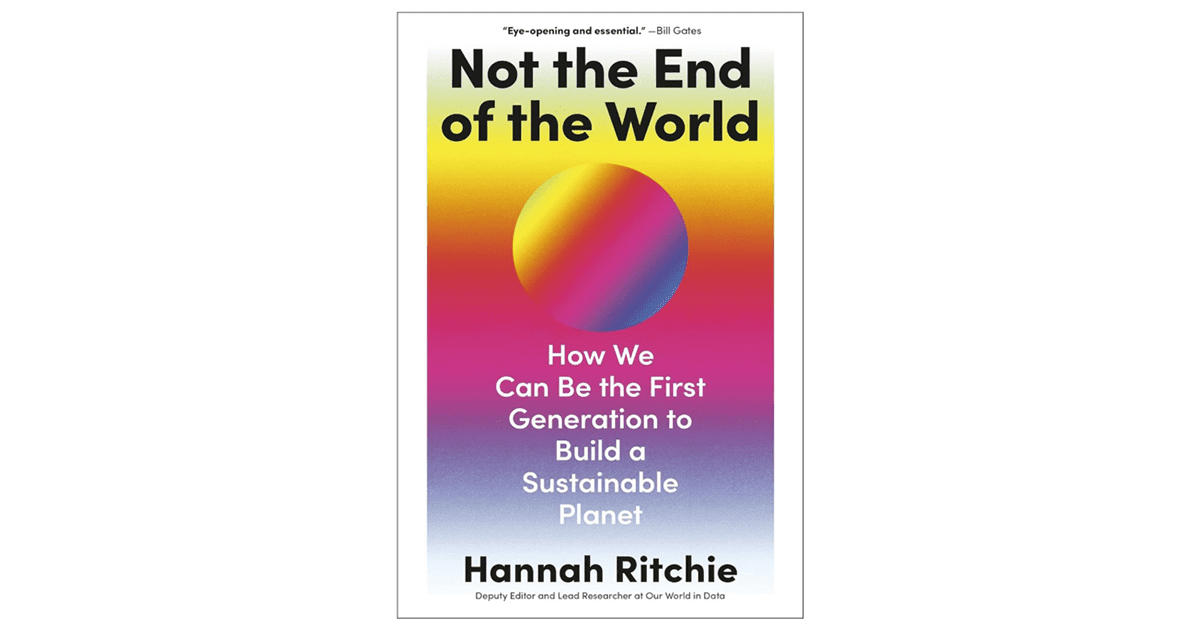
Apr 18, 2025 Not the End of the World: How We Can Be the First Generation to Build a Sustainable Planet (New York: Little, Brown and Spark)
In her 2024 book, Not the End of the World, Hannah Ritchie (Scottish data scientist and researcher at the University of Oxford) begins by noting surveys that document how pervasively young people today feel that “humanity is doomed” and “the future is frightening.” She responds that their assumptions are wrong and argues that “the world needs more urgent optimism.” Ritchie explains that her motivation for highlighting the numerous positive trends in the world was inspired by Hans Rosling, a Swedish optimist known for his TED talks. Rosling also wrote Factfulness and was behind the launch of Gapminder.
While grappling with a range of global problems, Ms. Ritchie explains that three things can be true at once: “The world is awful, yet the world is getting better in many ways, and the world can be much better.”
Ritchie draws on her work as the Head of Research for “Our World in Data” and attempts to correct misperceptions about a range of issues, each occupying a chapter, as discussed below. Her conclusions and recommendations are familiar but are supported in the book by many graphs with trendlines spanning decades and longer. For each problem she reviews, she recommends how systematic changes could reverse global issues. However, she does not predict whether such systematic change is likely to happen.
Ritchie heavily emphasizes technological solutions, such as renewable energy, nuclear, and agricultural innovations (including reducing meat consumption), as paths to sustainability. She emphasizes the benefits of electrification and transitioning to renewable energy sources to significantly reduce our carbon footprint.
Throughout her book, Ritchie draws on examples and experiences from Europe rather than from more challenging regions of the world. This leads her to conclude that population growth is a problem of the past, but not today, overlooking trends in China, India, or Africa.
Disasters
Ritchie’s observations regarding many trends are fair and accurate. Ritchie is correct that death rates from disasters have fallen over the last half century, as have famine deaths and deaths from conflicts. However, the number of people exposed to disasters keeps increasing, including populations affected by flooding and mass forced migration.
Extinctions and Biodiversity
Ritchie comments that biodiversity loss and species extinctions are very complicated. Unlike climate change, which captures more attention, she argues that habitat destruction, such as deforestation for agriculture, is the primary cause of extinctions today. Yet, she’s skeptical of habitat protection programs. Instead, she notes that a “by-product of slowing climate change, fixing our food systems, stopping deforestation, ending plastic pollution, and protecting our oceans is that we stop piling pressure on the species around us.”
She dedicates a section to whale conservation as a source of hope. She observes how whale populations were hunted to near extinction, at which point whaling wound down. “It will take a long time for whale populations to recover. But the world acted just in time to allow them to do so.” Ritchie discusses the interconnectedness of life and writes that worms, insects, and bacteria are as important for biodiversity as cute mammals.
However, I found some of her comments on biodiversity decline troubling. She states, “Deforestation, hunting, fishing and farming are all direct threats to our wildlife. These activities put thousands of species at risk of extinction. Many species face more than one threat. The good news is that the solutions are cross-cutting: eating less meat would reduce the land we use for farming, climate change and biodiversity loss. Stopping deforestation will reduce habitat loss and greenhouse gas emissions.” She selects a few species that have seen numbers rebound and draws optimism for the rest, despite the unrelenting extinction rate. Once extinct, species do not come back.
Swelling numbers of middle-class consumers worldwide will lead to a growing demand for cars and goods. However, Ritchie remains optimistic and notes that per capita CO2 emissions peaked a decade ago. As the world population continues to grow, she comments, “Per capita measures will peak first, then it’s a tug-of-war over whether our impacts per person will fall more quickly than the population is growing.” This comment reflects an optimistic belief that per capita consumption will fall fast enough to reduce the impact on the global ecosystem caused by a growing number of humans.
Plastics
Ritchie devotes a chapter to the problem of plastic waste in the oceans, arguing that the solutions are straightforward. We already know of ways to break down plastic chemically and can regulate its trade. She writes, “Invest in waste-management systems and we could stop this. The biggest barrier is money. Most of the world’s plastic pollution now comes from low- and middle-income countries. Rich countries have a responsibility as manufacturers and trade partners to help other countries make landfills and recycling centers a priority. Work together, and plastic pollution will be solved in the next few decades.”
Air Pollution
Ritchie recounts how air pollution has decreased dramatically in some of the world’s most polluted cities, leading to measurable human health benefits due to policy changes demanded by local citizens.
Food
Looking at food systems, she argues that eating locally-sourced food is not always better for the environment. She consistently advocates against eating meat. Plant substitutes for meat are unequivocally better for the planet: “If both McDonald’s and Burger King made all their burgers a 50:50 blend of beef and soy, it would save 50 million tons of greenhouse gases each year.” Additionally, she points out, “Switch your beefburger for a Beyond Meat or Impossible Burger and you’ll cut emissions by around 96%.” Developing a global food system that emphasizes plant protein consumption would also benefit many wild animal populations.
Ritchie writes about persistent hunger in the world. However, she argues that such hunger is due to a lack of political will and that the existence of surplus food in some countries means that malnutrition in low-income countries is self-imposed. Such a comment results from viewing the world in broad brush strokes without appreciating the enormous differences between countries.
She does not address the ongoing famines in countries like Yemen, Sudan, Nigeria, and Somalia, or regions where malnutrition remains a significant issue. Instead, she writes in general terms about the whole world, observing that crop yields could be higher, meeting the needs of growing populations.
Ritchie observes: “in the poorest countries, farmers use very little fertilizer. They can’t afford it. This is bad for them because they get poor yields and earn little money. It’s also bad for the planet because they need to use more farmland. As they get a little richer, fertilizer use starts to rise. Crop yields improve. But, eventually, the focus shifts toward using these inputs more efficiently. Fertilizer use doesn’t fall to zero, but farmers learn to use just the right amount to give crops the nutrients they need.”
Final Comment
In conclusion, Not the End of the World is a valuable read, some of the comments above notwithstanding. The book consolidates important, eye-opening data on many global trends. The author’s numerous conclusions and recommendations result in an eminently suitable volume for book club discussions and debates, as well as a reading for university graduate courses.
___________________________________________________________________________
Steven Hansch is a humanitarian aid specialist with extensive field, management, and evaluation experience. He teaches at several universities and serves on several nonprofit boards involved in human development and humanitarian aid. Leslie Barcus has served on national and international animal protection organization boards. Her professional activities include work in more than forty countries addressing animal protection, microfinance, biodiversity conservation, organizational capacity building, and international economic development.